

You’ve hooked the fish of a lifetime, your drag sings, and then—snap. Your fly fishing tippet breaks again, leaving you staring at a curly pigtail knot and wondering what went wrong. Tippet breakage ranks among the most frustrating problems in fly fishing, costing anglers countless fish and undermining confidence on the water. Most anglers blame weak tippet or bad luck, but the real culprits are usually hiding in plain sight.
This article reveals the six primary reasons your fly fishing tippet keeps breaking and provides specific solutions to dramatically improve your landing rate without simply upsizing to heavier material that compromises presentation.
Quick Answer: Fly fishing tippet breaks primarily due to degraded knot strength (retaining only 60-70% of line strength with common knots), UV exposure reducing breaking strength by 20% after 100 hours of sunlight, microscopic abrasion creating invisible weak points, and material degradation from improper storage or age rather than a single catastrophic failure.
Key Evidence: Independent knot‑testing has shown that while some modern terminal knots can approach or even exceed a line’s rated strength, the improved clinch often tests lower, with efficiencies around 75–85% depending on line type and test method.
Context: This 30% strength loss through knot selection alone explains why anglers experience unexpected failures even with quality tippet material.
Key Takeaways:
- Knot selection matters more than tippet strength — switching from improved clinch to Davy or double surgeon’s knots can recover 25-30% lost strength
- UV exposure degrades tippet by 20% after 100 hours of direct sunlight, even when material appears intact (Scientific Anglers tippet material research)
- Microscopic abrasion reduces strength by 40-60% at damaged points, requiring mid-session inspection and replacement
- Temperature affects material properties — nylon becomes brittle below 40°F while fluorocarbon stiffens, compromising knot integrity
- Proper storage extends tippet life to 2-3 years versus months when exposed to heat, humidity, or chemical contamination
The Hidden Weakness in Your Knots
Most fly fishing tippet failures occur at knots, not because the material breaks but because the knot never achieved full strength in the first place. The improved clinch knot—taught to nearly every beginning angler—retains only 60-70% of line strength, while alternatives like the Davy knot and double surgeon’s knot preserve 85-95% when tied correctly (Orvis knot performance testing).
This means anglers unknowingly reduce their effective fly fishing tippet strength by 30-40% through knot selection alone, creating a weak point that fails before the tippet material reaches its breaking point. Rather than compensating for weak knots by upsizing tippet diameter, master three essential knots that preserve 85-95% of rated strength across all materials.
Tom Rosenbauer states, “Most tippet failures are self-inflicted. The material is almost never the problem—it’s either a poorly tied knot, damaged tippet that should have been replaced, or asking 5X to do 3X’s job” (Orvis Fly Fishing Podcast). His perspective emphasizes that technical skill and judgment drive outcomes more than equipment quality.
Fluorocarbon’s different properties—greater stiffness, lower elongation—make it particularly sensitive to knot choice. Improved clinch knots on fluorocarbon larger than 4X test especially poorly. Friction heat during dry knot tightening can reach temperatures that weaken material at the molecular level, making lubrication especially critical with fluorocarbon.
Three Essential Knots That Won’t Fail You
The Davy knot works best for fly-to-tippet connections, offering the simplest high-strength option and proving especially effective on small flies. The double surgeon’s knot handles tippet-to-leader connections with excellent strength retention and works reliably across diameter mismatches. Reserve the improved clinch as a backup only—it’s acceptable for nylon tippet 4X and lighter, but avoid it with fluorocarbon or heavy tippet. Practice each until you can tie them with eyes closed, since field conditions often compromise technique.
Environmental Degradation You Can’t See
Your fly fishing tippet begins degrading the moment you remove it from the package, with environmental factors causing invisible strength loss long before material shows visible damage. Nylon monofilament loses approximately 20% of breaking strength after 100 hours of direct sunlight, with fluorocarbon showing slightly better UV resistance but still experiencing measurable degradation (Scientific Anglers tippet material research).
This explains why tippet stored improperly or left on reels between seasons fails unexpectedly, even when it appears intact and hasn’t been used extensively. Environmental degradation works silently—your tippet can lose 20-30% of its strength while still looking perfectly serviceable, making preventive replacement more effective than reactive upsizing.
Temperature affects material behavior in ways most anglers don’t consider. Nylon becomes more brittle in cold water below 40°F, while fluorocarbon maintains more consistent properties but becomes stiffer, affecting knot integrity (Scientific Anglers tippet material research). This explains seasonal variation in breakage patterns and why the same tippet and knots that perform well in summer may fail more frequently during spring and fall fishing.
Properly stored tippet maintains 90% of rated strength for 2-3 years, but material exposed to heat, humidity, or chemical contamination from insect repellent and sunscreen can degrade within months regardless of actual fishing time (Trout Unlimited tippet maintenance guide). Calendar age and storage conditions predict failure better than the amount of fishing done with a particular spool, challenging the common practice of using old tippet until it runs out.
Floatants, strike indicators, and sunscreen contain chemicals that speed monofilament degradation when in direct contact. Apply floatant only to the fly and the last inch of tippet, never to the entire leader system.
Abrasion and Battle Damage During Fishing
Even microscopic nicks from rocks, vegetation, or fish teeth can reduce breaking strength by 40-60% at the damaged point, with fluorocarbon showing less abrasion resistance than commonly believed in certain conditions. This establishes why fly fishing tippet often breaks during fights with fish that have taken line around structure, and why inspecting tippet regularly for rough spots proves necessary.
Tournament anglers tracking landing percentages identify that most failures occur at predictable points—the knot connecting tippet to leader, the knot attaching fly to tippet, and a zone 6-12 inches above the fly where abrasion accumulates during fish fights. Abrasion creates damage you can’t see but can feel—running tippet through your fingers reveals rough spots, stiff sections, and texture changes that indicate compromised material.
George Daniel notes, “Anglers routinely sacrifice 40% of their tippet strength through bad knots, then compensate by going up two sizes in diameter, which defeats the whole purpose of light tippet” (George Daniel leader systems). His observation highlights how anglers often address symptoms rather than causes.
Prevention costs pennies in material but dramatically improves landing percentages—most breakage occurs from battle damage that accumulates invisibly during fishing, not from catastrophic single events. Replace terminal tippet (last 18-24 inches) every 2-3 hours of fishing, even when material appears undamaged, to eliminate accumulated microabrasion. Check tippet before each session, after landing any fish, and whenever tippet contacts structure.
The Three-Point Inspection System
Before each fishing session, run tippet through your fingers from knot to fly, feeling for rough spots or stiff sections. After landing any fish, re-inspect the terminal 12 inches where fish teeth and handling cause concentrated damage. Whenever tippet touches rocks, logs, or vegetation, check immediately for structure contact damage. Any detected roughness, nicks, or stiffness warrants immediate replacement rather than gambling on compromised material.
Practical Solutions That Actually Work
Consider the entire leader-to-tippet-to-fly connection as an integrated system where the weakest link determines overall performance. Follow the rule that tippet diameter should roughly equal hook wire diameter for balanced presentation and appropriate strength—using 6X on size 10 streamers creates mismatches where tippet breaks before hooks straighten.
Stretch fresh fly fishing tippet gently between your hands before tying to eliminate coils from spooling. Material with memory creates uneven loading in knots and reduces performance. Proper tippet management requires spending 30 seconds on inspection and maintenance every hour rather than losing 30 minutes of frustration after preventable breakage costs you a trophy fish.
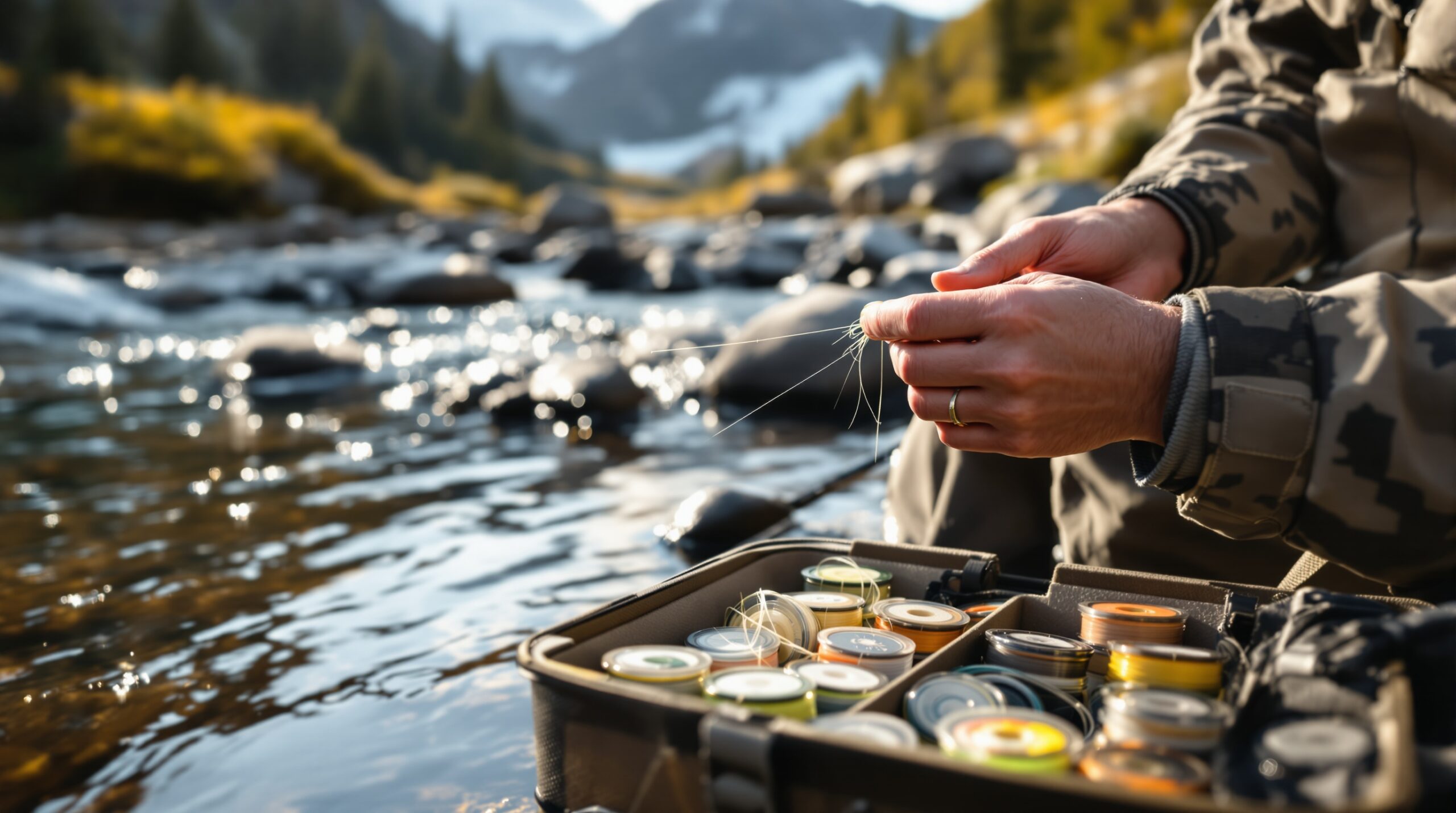
Keep spools in dark, cool, dry locations inside tackle bags or dedicated containers. Never store tippet in vehicles where temperature extremes speed degradation. Keep material away from insect repellent, sunscreen, and fuel vapors. Note purchase dates on spools and discard after three years regardless of remaining material.
Cut back and retie fly connections every 2-3 hours, eliminating the zone where microabrasion concentrates. Apply saliva or water before cinching knots tight, as friction heat during dry tightening weakens material. Tighten steadily rather than jerking knots closed.
Choose nylon for superior knot strength and shock absorption in dry fly fishing and situations with sudden runs. Select fluorocarbon for subsurface presentations where low visibility and sink rate matter more than knot strength. Understanding when to use different line types helps you build balanced systems.
Conclusion
Your fly fishing tippet breaks because of a combination of factors you control—knot selection that preserves only 60-70% of line strength, UV exposure reducing material strength by 20%, invisible abrasion damage, and environmental degradation from improper storage. The solution isn’t heavier tippet that compromises presentation, but rather mastering high-efficiency knots, implementing regular inspection and replacement, and protecting material from environmental degradation through proper storage.
Start with three changes today—learn the Davy and double surgeon’s knots, establish a two-hour tippet replacement habit, and transfer all spools to cool, dark storage away from chemicals. These simple practices will improve your landing rate more than any equipment upgrade. Most tippet failures are preventable, not inevitable.
Frequently Asked Questions
What is fly fishing tippet?
Fly fishing tippet is the final section of thin fishing line that connects your fly to the leader. It’s typically the lightest part of your line system and determines both fish presentation and breaking strength for landing fish.
Why does my tippet break at the knot?
Most tippet breaks at knots because common knots like the improved clinch only retain 60-70% of line strength. Poor knot choice reduces your effective tippet strength by 30-40% before the material reaches its actual breaking point.
What are the strongest knots for fly fishing tippet?
The Davy knot and double surgeon’s knot preserve 85-95% of tippet strength when tied correctly. These outperform the popular improved clinch knot, which only retains 60-70% of rated breaking strength.
How often should I replace my tippet?
Replace terminal tippet every 2-3 hours of fishing to eliminate accumulated microabrasion damage. Even invisible nicks from rocks, vegetation, or fish teeth can reduce breaking strength by 40-60% at damaged points.
Does UV light weaken fishing tippet?
Yes, nylon tippet loses approximately 20% of breaking strength after 100 hours of direct sunlight exposure. This degradation occurs even when material appears intact, making proper storage essential for maintaining strength.
How should I store my tippet spools?
Store tippet spools in cool, dark, dry locations away from heat, chemicals, and UV light. Properly stored tippet maintains 90% strength for 2-3 years, while improper storage can cause degradation within months.
Sources
- Orvis – Tippet strength testing, knot efficiency research, expert commentary from Tom Rosenbauer, and instructional podcast content on leader systems
- Scientific Anglers – Material science analysis of nylon and fluorocarbon properties, UV degradation data, and temperature effects on tippet performance
- Trout Unlimited – Tippet storage recommendations, age-related degradation research, and chemical contamination effects
- George Daniel Fly Fishing – Competitive angler perspectives on knot selection, leader system design, and performance optimization strategies