

Fly fishing frustrates newcomers because the casting mechanics fundamentally contradict everything they know from conventional fishing—you’re casting the weight of the line itself, not a weighted lure. This counterintuitive physics, combined with reading water and managing drag, creates a steep learning curve that drives many beginners away during their first season on the water.
Maybe you’ve stood on a riverbank, watching your line tangle midair while experienced anglers nearby make casting look effortless. That frustration is normal. Fly fishing for beginners is not about mastering complex techniques immediately. It is structured learning that addresses why the sport feels challenging and applies straightforward solutions to casting, positioning, and gear choices that transform early frustration into the peaceful rhythm experienced anglers cherish.
Quick Answer: Fly fishing for beginners feels hard because casting relies on loading the rod with the fly line’s weight rather than a heavy lure, requiring precise timing and deliberate pauses that feel counterintuitive.
Definition: Fly fishing for beginners is the process of learning to cast nearly weightless imitations using the fly line’s mass to load the rod, then presenting those flies naturally to feeding fish.
Key Evidence: According to Tom Rosenbauer at Orvis, beginners “really only need a rod, a reel, line, leader, snips, and a box of flies” to get started successfully.
Context: Simplicity builds confidence faster than perfect technique during the learning phase.
Fly fishing works through three mechanisms: it externalizes the challenge of precise presentation, creates a feedback loop between your casting mechanics and the fish’s response, and rewards patience over power. When you master the pause that loads the rod properly, position yourself where fish actually feed, and manage drag that betrays artificial drift, you shift from random casting to targeted fishing. That combination reduces frustration and increases choice in how you approach each cast.
Key Takeaways
- Casting physics differ fundamentally from conventional fishing—you cast the line’s weight, not the lure’s
- The pause creates the cast—rushing without letting the back cast fully extend causes tangles and weak presentation
- Position beats distance—fish from downstream using stream noise for stealth, gridding water systematically
- Gear minimalism prevents overwhelm—start with essentials only to focus on fundamental skills
- Reading water matters most—seams where fast meets slow current concentrate feeding fish
The Casting Mechanics That Trip Up Fly Fishing for Beginners
You might notice your casting feels backwards at first—that’s because fly fishing relies on loading the rod with the weight of the fly line rather than a heavy lure, requiring precise timing, straight rod-tip path, and smooth acceleration to stops. According to The Fly Crate, this fundamental difference creates the steepest part of the learning curve because muscle memory from other fishing styles actually works against you.
If you’ve fished with spinning or baitcasting gear, your instincts betray you on the water. Conventional casting uses the lure’s weight for momentum—you accelerate through the cast and let the weight carry the line. Fly casting bends the rod against the line’s resistance, storing energy in the rod’s flex before releasing it to propel nearly weightless imitations.
One common pattern looks like this: you start with enthusiasm, make several quick back-and-forth motions without pausing, watch your line collapse in a heap, then try to power through with more aggressive casting. The harder you try, the worse it gets. This happens because the sequence follows a specific rhythm: start low, accelerate smoothly to back stop where the rod bends and line straightens behind you, pause for full extension, then forward stop and drop for straight-line presentation.
Research from The Fly Crate shows that rushing past the pause represents the most common beginner mistake, collapsing the entire casting sequence. The pause when the line fully extends behind the rod represents the single most important checkpoint in the cast—the forward cast cannot properly load the rod if the back cast hasn’t completed its work.
Practice Before Water Time
Yard practice builds muscle memory without the distraction of eager fish or moving water.
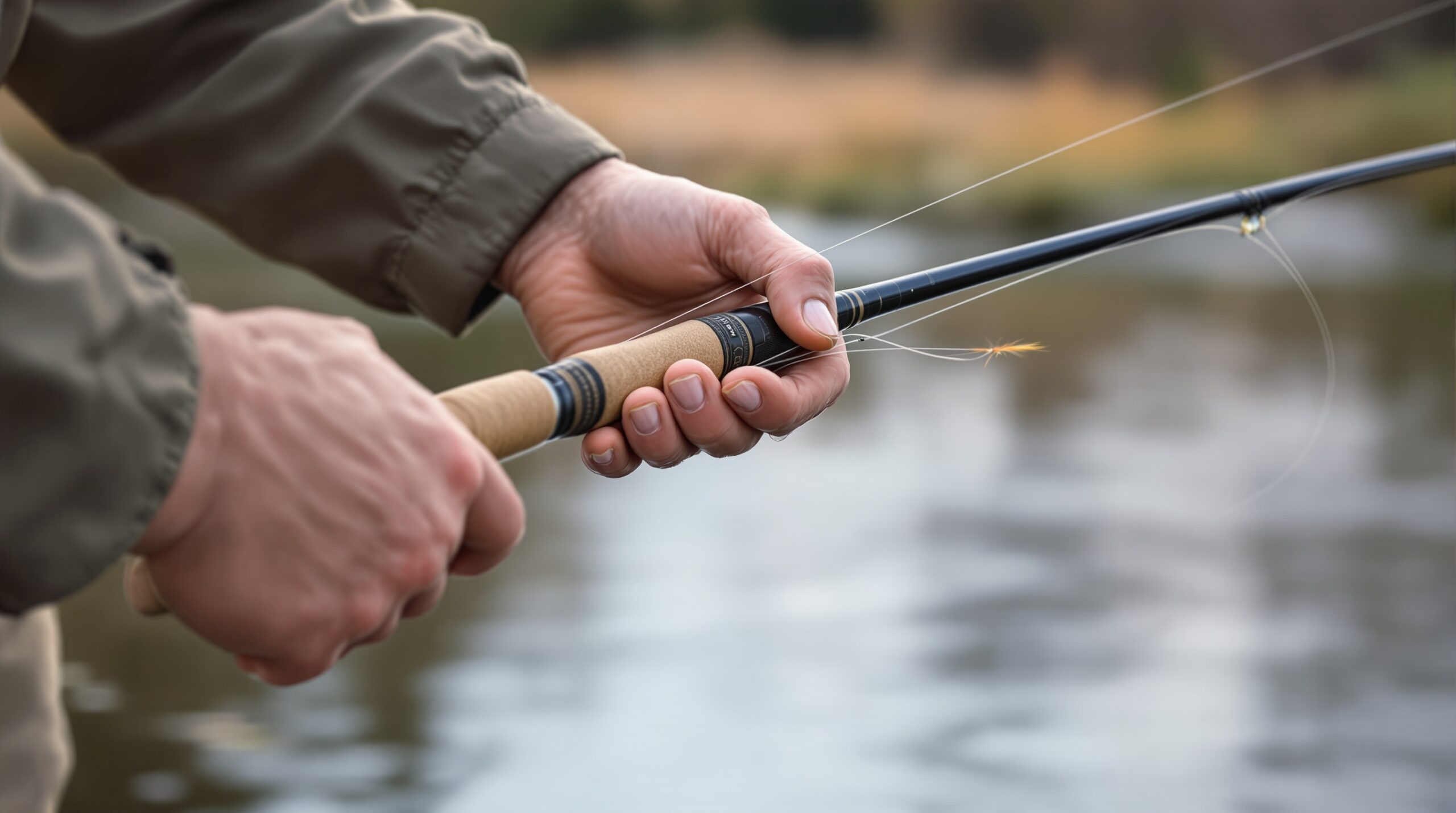
- Grass casting: Use yarn instead of a fly to avoid hooks catching during inevitable tangles
- Count the pause: Say “one-one-thousand” as line extends behind, feeling the rod tip pulse when extension completes
- Focus exclusively: Master this timing before adding the complexity of reading water and spotting fish
Where Fish Actually Hold (And Why You Keep Missing Them)
Maybe you’ve spent hours casting to the deepest pools or fastest runs, wondering why nothing bites. Reading water for seams—those bubble and debris lines where fast meets slow current—determines success more than casting distance. According to guidance from The Fly Crate, you should grid fish from the inside edge upstream to avoid spooking trout, using stream noise for stealth wading.
These transition zones create insect superhighways that concentrate food, making them prime holding lies where trout position in slower water adjacent to fast current that delivers meals. Most beginners cast to the most obvious water—deep pools or fast runs—while fish actually feed in the subtle edges where currents meet.
The same current differentials that attract fish also create your biggest presentation challenge: drag on the fly line that pulls your imitation unnaturally across the surface. Research shows that unnatural drift caused by drag betrays artificial presentation more quickly than incorrect fly pattern selection. You can have the perfect match for what’s hatching, but if your fly drags across the surface like a tiny water skier, fish refuse it immediately.
Wade quietly into a downstream position relative to promising water, using stream noise to mask your approach. Fish upstream in a grid pattern, covering the water nearest you first before extending range. This systematic coverage ensures you don’t telegraph your presence to upstream fish by casting over them to reach distant water.
The Grid Method for Beginners
Systematic coverage replaces aimless casting with purposeful presentation that actually reaches fish.
- Mental division: Divide promising water into narrow threads you can cover with short, accurate casts
- Inside-out progression: Start with water closest to you, working outward to avoid spooking fish upstream
- Observation first: Spend 15 minutes watching for rises, seams, and insect activity before making your first cast
Gear Choices That Build Confidence for Fly Fishing for Beginners
When you walk into a fly shop, the wall of gear can feel overwhelming. Tom Rosenbauer advises keeping starter gear simple: “you really only need a rod, a reel, line, leader, snips, and a box of flies… keep it simple at first.” This expert guidance from Orvis counters the overwhelming marketplace of fly fishing accessories—focusing on essentials prevents decision paralysis and lets you concentrate on fundamental skills.
Match fly line weight to rod designation—a 6-weight rod with 6-weight line provides the standard setup. However, beginners benefit from slightly heavier line, such as 7-weight line on a 6-weight rod, because it loads the rod easier during short practice casts. According to The Fly Crate, this extra mass provides more tangible feedback, helping you feel the rod loading properly during the learning phase.
A 5- or 6-weight rod with weight-forward floating line provides versatility for most beginner situations on the water. This mid-weight setup handles everything from small stream trout to modest bass without requiring specialization that limits where you can fish effectively.
While minimalists strip gear to absolute basics, polarized sunglasses deserve inclusion from day one because reading water and spotting fish matters as much as casting mechanics. Add nippers for trimming line and forceps for safe hook removal, but resist the temptation to buy specialized gear before mastering fundamentals.
Essential Gear Only
Starting simple prevents equipment overwhelm while you build fundamental skills.
- Rod and reel combo: 5-6 weight with matching or slightly heavier line for easier loading
- Basic flies: Woolly buggers, elk hair caddis, and parachute adams cover most situations
- Simple accessories: Nippers, forceps, and polarized glasses—nothing more until you know what you actually need
Why Fly Fishing for Beginners Matters
Fly fishing offers a meditative practice that rewards patience and observation—skills increasingly rare in modern life. The learning curve, while steep, teaches persistence through deliberate practice rather than instant gratification. Understanding why the sport feels hard prevents premature quitting during the frustrating early phase when muscle memory fights against new mechanics. That patience is where choice lives between giving up and discovering a lifetime pursuit that combines technical skill, natural observation, and peaceful time on the water.
Conclusion
Fly fishing for beginners feels hard because the physics of casting, the subtleties of reading water, and the precision of drag-free presentation all demand skills that contradict conventional fishing instincts. The solution lies in accepting the learning curve: practice the pause until it becomes automatic, position yourself downstream of fish rather than casting maximum distance, and resist gear overwhelm by starting with essentials only. The frustration you feel during early attempts isn’t a sign you’re doing it wrong—it’s evidence you’re learning something genuinely challenging. Understanding common beginner mistakes and following proper fundamentals will reward your persistence with a lifetime of satisfying days on the water.
Frequently Asked Questions
What is fly fishing for beginners?
Fly fishing for beginners is learning to cast nearly weightless imitations using the fly line’s mass to load the rod, then presenting those flies naturally to feeding fish in rivers and streams.
Why does fly fishing feel so hard for beginners?
Fly fishing feels hard because casting relies on loading the rod with the fly line’s weight rather than a heavy lure, requiring precise timing and deliberate pauses that feel counterintuitive to new anglers.
What gear do beginners need for fly fishing?
According to Tom Rosenbauer at Orvis, beginners really only need a rod, reel, line, leader, snips, and a box of flies. Start with a 5-6 weight rod and matching line for versatility.
What is the most common fly fishing mistake beginners make?
The most common beginner mistake is rushing past the pause during casting. You must let the back cast fully extend behind the rod before starting the forward cast to properly load the rod.
Where should beginners look for fish when fly fishing?
Look for seams where fast meets slow current, marked by bubble and debris lines. These transition zones concentrate food and create prime holding lies where trout position to feed.
How should beginners practice fly casting?
Practice in your yard using yarn instead of a fly to avoid hooks catching during tangles. Count “one-one-thousand” as the line extends behind you to develop proper pause timing before water time.
Sources
- Orvis (YouTube) – Tom Rosenbauer’s beginner guidance on essential gear minimalism and getting started
- The Fly Crate – Comprehensive step-by-step casting mechanics, water reading techniques, and grid fishing methods
- Wet Fly Swing – Foundational instruction on casting principles and getting started
- BC Fishn – Essential gear recommendations for beginners
- Ontario Trout and Steelhead – Line weight matching guidance and beginner equipment setup
- Fish Talk Magazine – Common beginner mistakes and lessons learned on the water