
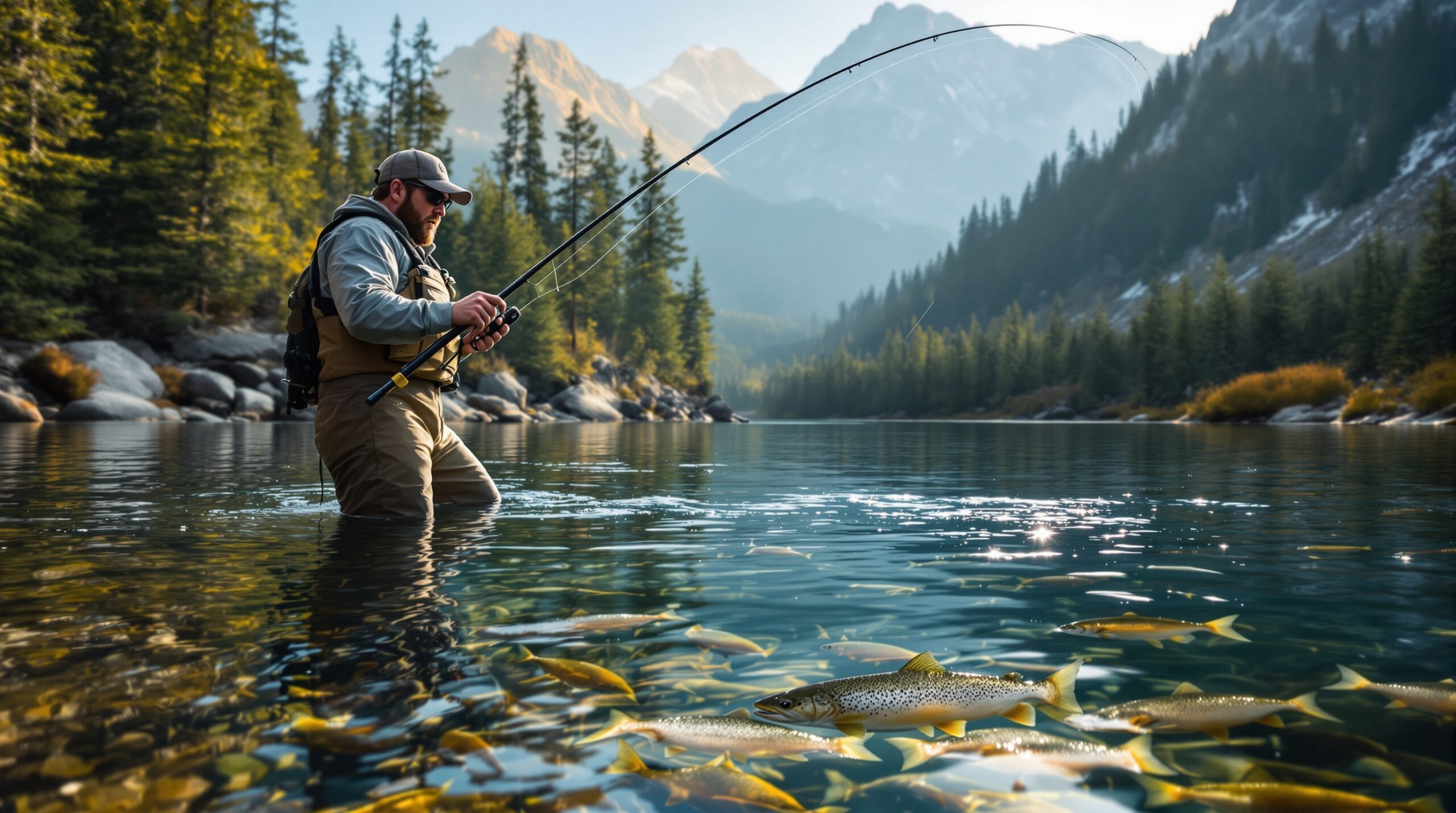
Most fly fishing guides teach you to cast before you can catch fish—and that’s exactly the problem. While beginners practice their backcast and perfect their loop, fish swim past unnoticed because the fly spends more time in the air than in the water. According to professional guides, excessive false casting is the #1 mistake keeping novices from success, yet it’s rarely the focus of beginner instruction. Understanding what guides miss in their instruction—from water reading to stealth—transforms frustrating practice into productive fly fishing for beginners.
Fly fishing for beginners is not about perfecting casting mechanics. It is strategic fishing that prioritizes keeping flies on productive water over demonstrating technical skill.
Quick Answer: Most fly fishing beginner guides overemphasize casting mechanics while neglecting the strategic skills that actually catch fish: reading water, approaching with stealth, and keeping flies on the water instead of in the air.
Definition: Fly fishing for beginners is strategic angling that prioritizes observation, stealth, and presentation time over casting demonstrations.
Key Evidence: According to Orvis News, professional guides identify excessive false casting as the #1 mistake, with Joe Demalderis noting “fish are caught with flies in the water.”
Context: The pursuit of perfect casts undermines productive fishing time.
Key Takeaways
- False casting is the #1 beginner mistake—fish are caught with flies in water, not air
- Premature pickups spook more fish than imperfect casts that land short
- Water reading skills matter more than casting distance for locating feeding fish
- Stealth approach from downstream prevents spooking fish before your first cast
- 10-15 minute warm-up before fishing establishes rhythm and identifies equipment issues
The False Casting Trap That Guides Overlook in Fly Fishing for Beginners
You might have experienced this during your first few outings: standing waist-deep in promising water, practicing that 10 o'clock to 2 o'clock motion while fish rise just beyond your reach. Traditional instruction emphasizes casting mechanics while treating time-on-water as secondary. This creates technically proficient casters who struggle to hook fish consistently.Professional guides like Joe Demalderis of Cross Current Guide Service see this pattern repeatedly. As Demalderis notes, “You can’t refute the fact that fish are caught with flies in the water.” Every moment spent waving line in the air is a lost opportunity for a strike. This observation cuts through the complexity of instruction to identify the single behavior change with greatest impact on success rates.
Capt. Chuck Hawkins identifies a related pattern that many of us recognize: anglers “make a cast that is close (e.g. short), but not close enough, and then rip the fly off the water to make another cast. Almost always, this results in the fish being spooked.” The impulse to achieve perfection destroys opportunities already in play.
One common pattern looks like this: you spot a rising trout, make your approach, and land the fly two feet short of the target. Instead of letting the drift complete, you immediately pick up for another cast. The fish, already aware of your presence, disappears at the disturbance. That “close enough” cast might have drawn a strike if given time to work.
Breaking the Habit
Beginners often treat fly rods like baseball bats, bringing them back too far and prioritizing distance over accuracy. This habit transfers poorly from conventional fishing experience.- One-cast rule: Load the rod once, land the fly, complete the drift
- Short-cast acceptance: Let "close enough" casts finish rather than recasting
- Practice rhythm: 10-15 minutes of land-based casting before fishing
Water Reading and Stealth Skills Missing from Beginner Instruction
Here's what happens when guides focus on casting first: beginners learn beautiful loops but can't identify where fish actually hold. They cast randomly rather than targeting productive water features like seams, eddies, and rises. Technical casting skill means nothing without strategic thinking about placement.Research by trout behavior specialists shows that fish position themselves in predictable locations based on current, cover, and food sources. Yet most instruction skips this fundamental knowledge in favor of mechanical repetition.
You’ve probably noticed how some anglers seem to find fish effortlessly while others work the same water without success. The difference isn’t casting ability—it’s observation. Successful anglers spend 5-10 minutes watching water before making their first cast. They identify current seams where fast and slow water meet, note structure like boulders or undercut banks, and watch for rises that indicate feeding activity.
Loud approaches and poor positioning spook fish before the first cast reaches water. In clear conditions, fish see you as well as you see them. Downstream positioning and quiet wading are fundamental skills that guides mention but rarely emphasize as essential to success.
Practical Stealth Techniques
Beginners wade heavily into position, creating pressure waves and grinding rocks that telegraph their presence. These disturbances travel farther underwater than most anglers realize.- Downstream approach: Position below feeding fish whenever possible
- Slow wading: Place feet carefully to minimize disturbance
- Bank concealment: Use vegetation for cover; cast from shore when possible
What Fly Fishing for Beginners Should Prioritize Instead
Maybe you've stood in a fly shop overwhelmed by hundreds of pattern choices, wondering which flies actually work. Guides recommend matched outfits for local conditions and limiting fly boxes to proven patterns rather than endless options. Studies by Fly Fisherman magazine show that basic patterns matching local insects outperform fancy alternatives consistently.The “smooth delivery, not line speed” philosophy prioritizes presentation quality over casting athleticism. Success comes from maximizing opportunities for fish to see your fly, not from demonstrating casting prowess. You might notice that the most successful anglers on the water aren’t necessarily the ones making the longest casts—they’re the ones keeping flies on productive water.
Slack line prevents solid hook sets, while excessive tension creates unnatural fly movement. Maintain minimal slack during drift by keeping rod tip low and following the fly’s movement. When fish strike, lift the rod to 45 degrees with smooth pressure rather than jerking violently. The trout often hook themselves on dry flies, so your primary job involves not pulling the fly away during the take.
Target seams where different current speeds meet, creating feeding lanes where trout hold in slower water while monitoring faster current for drifting insects. One good drift through productive water beats a dozen casts to empty water. This strategic thinking transforms casting from exercise into hunting, where each presentation serves a specific purpose.
Strategic Fly Selection
Modern fly fishing for beginners emphasizes effectiveness over variety. Local patterns matched to observed hatches consistently outproduce exotic alternatives.- Match the hatch: Observe insects on the water before selecting flies
- Local favorites: Ask guides and shops for proven regional patterns
- Size matters: Accurate sizing often trumps exact pattern matching
Why Fly Fishing for Beginners Matters
The disconnect between what guides teach and what actually catches fish keeps capable casters from becoming successful anglers. Recognizing that strategic skills—water reading, stealth, patience—matter more than technical perfection allows beginners to focus on productive fundamentals rather than endless casting practice. This reframing accelerates progression from frustrated practice to consistent success on the water. That shift from mechanical repetition to strategic thinking represents the difference between practicing fly fishing and actually fishing with flies.Conclusion
The most important lesson missing from fly fishing beginner guides isn't about casting mechanics—it's about keeping flies on the water where fish can actually strike them. Professional guides unanimously identify excessive false casting, premature pickups, and poor water reading as the mistakes that separate frustrating days from productive ones. By prioritizing observation over motion, stealth over distance, and strategic placement over perfect loops, you can bypass years of frustration and start catching fish consistently. Remember: fish are caught with flies in the water, not in the air. It's okay to let that short cast work—sometimes close enough is exactly what the fish ordered.Sources
- Orvis News - Expert guide perspectives on the most common beginner mistakes, including excessive false casting and premature fly pickup
- Fish Untamed - Analysis of casting mechanics errors and habits carried over from conventional fishing
- Fly Fish Star Valley - Current best practices for beginners including pre-fishing warm-up and water reading fundamentals
- Virginia Department of Wildlife Resources - Guidance on approach techniques, stealth, and positioning for productive fishing
- Fly Fishing Fix - Comprehensive overview of technical and strategic errors
- Montana Fish Tales - Practical applications and common error patterns
- Taylor Fly Fishing - Beginner mistake identification and correction strategies