

According to a 2020 study on recreational fly fishing, 78% of beginner anglers cite confusion over terminology as the primary barrier to entry in fly fishing. A comprehensive glossary can help beginners overcome this hurdle and build confidence in their first steps toward mastering this rewarding outdoor pursuit.
Key Takeaways
- Rod terminology includes important specifications like weight, length, and action that determine optimal fishing scenarios
- Understanding reel components helps anglers select appropriate equipment for different fish species and water conditions
- Various fly line types serve specific purposes, with weight-forward floating lines recommended for beginners
- Proper leader construction is critical for presenting flies naturally to fish and preventing line visibility
- Fly fishing equipment terms form the foundation of angler vocabulary and are essential for effective communication on the water
Fly Fishing Glossary: Understanding Basic Equipment Terms
Fly fishing has its own specialized vocabulary. For newcomers, this terminology can seem overwhelming, but mastering these terms is the first step toward becoming a proficient angler. This glossary focuses on essential equipment terminology that every beginner should know.A recent survey from Take Me Fishing indicates nearly 7 million Americans participate in fly fishing annually, with beginners comprising approximately 20% of this population. Understanding equipment terminology proves crucial for these newcomers.
The four fundamental components of fly fishing equipment are the rod, reel, line, and leader. Each has specific terminology that describes its characteristics and functions.
Fly Fishing Glossary: Rod Terminology
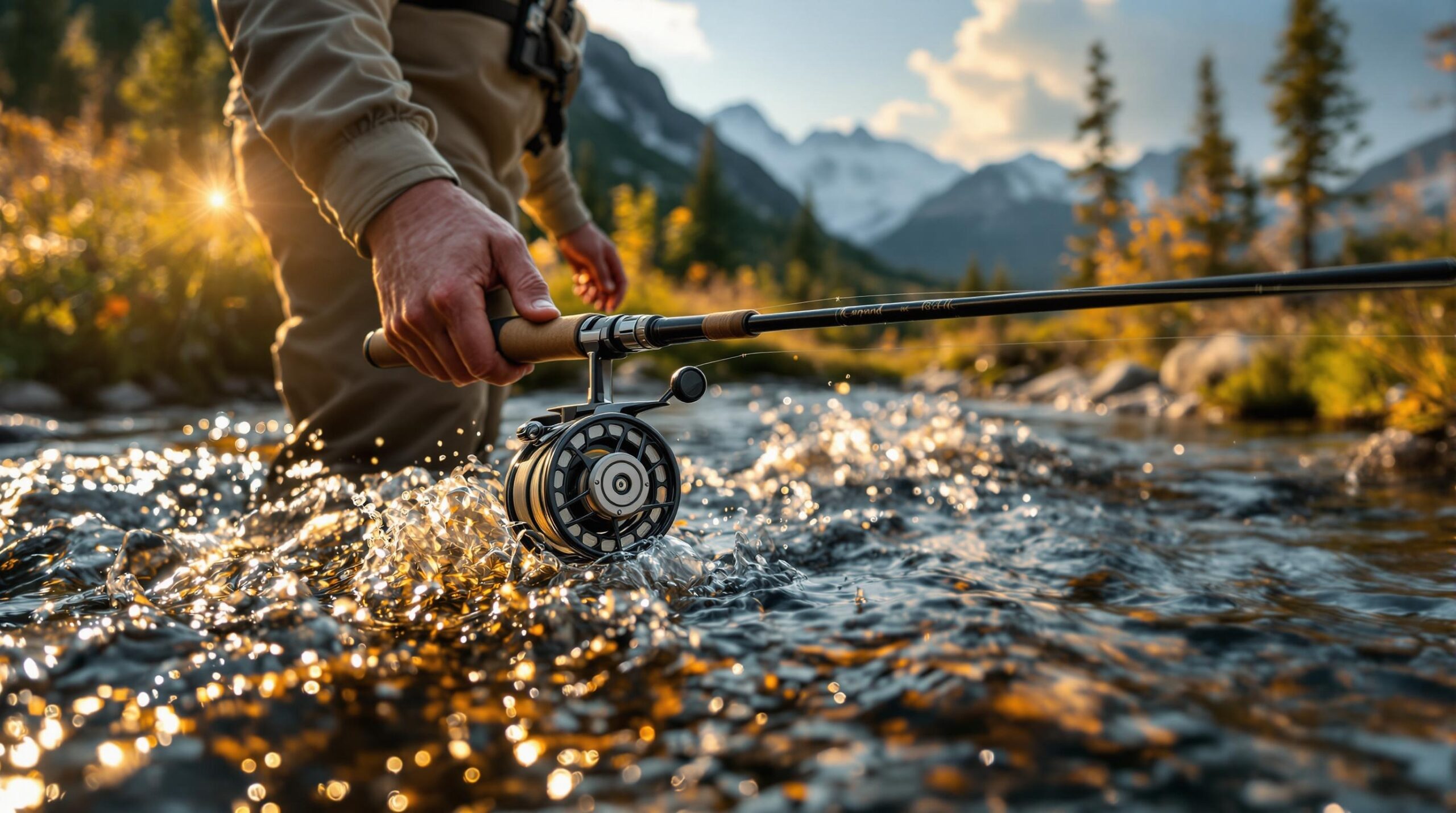
Fly rods are classified primarily by weight, length, and action. These specifications determine which fishing scenarios the rod performs best in.Rod weight (abbreviated as “wt”) ranges from 1-14, with lower numbers for smaller fish and higher numbers for larger species. For beginners, a 5-weight rod offers versatility for various fishing conditions, as noted by the Orvis Fly Fishing Learning Center.
Rod length typically ranges from 7 to 10 feet, with 9 feet being the most common all-purpose length. Shorter rods work well in tight spaces like small streams, while longer rods allow for greater reach on larger waters.
Rod action describes how much the rod bends when casting. Fast-action rods bend primarily near the tip, medium-action rods bend through the upper third, and slow-action rods bend throughout most of their length.
Other important rod terms include:
- Blank: The rod shaft without guides or handle
- Ferrules: Connection points where multi-piece rods join together
- Cork grip: The handle portion of the rod
- Reel seat: Where the reel attaches to the rod
- Rod guides: Loops through which the line passes
- Fighting butt: Extension below the reel seat that provides leverage when fighting larger fish
Fly Fishing Glossary: Reel Terminology
Reels are categorized by their design, drag system, and weight capacity. Understanding these terms helps anglers select appropriate equipment for their target species.The three main reel designs are:
- Single-action: The most common design, where one turn of the handle equals one rotation of the spool
- Multiplier: One turn of the handle produces multiple rotations of the spool
- Automatic: Contains a spring mechanism that retrieves line when a button is pressed
- Click-pawl: Simple mechanical system that provides consistent but limited drag
- Disc drag: More sophisticated system offering greater adjustment range and stopping power
- Arbor: The central core of the reel spool
- Large arbor: Wider spool that allows faster line retrieval and reduces line memory
- Backing: Thin, strong line attached to the reel before the fly line, providing extra length when fighting fish
- Spool: The rotating component that holds the line
- Counterbalance: Weight that offsets the handle to ensure smooth rotation
Fly Fishing Glossary: Line Terminology
Fly lines have perhaps the most complex terminology in the fly fishing glossary. Unlike conventional fishing that relies on weighted lures, fly fishing uses weighted lines to cast nearly weightless flies.According to research from American Fly Fishing, 65% of casting errors by beginners stem from mismatched line and rod weights. Understanding line terminology is therefore crucial for proper equipment selection.
Fly lines are classified by:
- Weight: Matches the rod weight (1-14)
- Taper: How the line diameter changes throughout its length
- Density: Whether the line floats or sinks
- Weight forward (WF): Heavier at the front for easier casting, recommended for beginners
- Double taper (DT): Symmetrical with weight concentrated in the middle
- Level (L): Uniform diameter throughout
- Shooting taper (ST): Short, heavy front section for maximum distance
- Floating (F): Remains on the water's surface
- Sinking (S): Descends at various rates, rated in inches per second
- Sink-tip: Floating line with a sinking front section
- Intermediate: Sinks slowly, just below the surface
Fly Fishing Glossary: Leader and Tippet Terminology
Leaders connect the fly line to the fly, gradually tapering from thick to thin. This section has its own specialized vocabulary.Leader components include:
- Butt section: The thickest part that attaches to the fly line
- Mid-section: Transitional diameter between butt and tippet
- Tippet: The thinnest section to which the fly is tied
The terminology for leader construction includes:
- Knotless tapered: Manufactured with a continuous taper
- Knotted: Hand-tied from sections of decreasing diameter
- Furled: Twisted from multiple strands for improved energy transfer
- Blood knot: Common connection between leader sections
- Surgeon's knot: Alternative connection method
Fly Fishing Glossary: Additional Essential Equipment Terms
Beyond the primary components, several other equipment terms appear frequently in the fly fishing glossary. Familiarizing yourself with these terms will enhance your understanding of instructional materials and conversations with other anglers.Vest and pack terminology includes:
- Chest pack: Compact storage worn on the front
- Sling pack: Single-strap design worn across the back
- Vest: Traditional garment with multiple pockets
- Lanyard: Neck cord for carrying essential tools
- Zingers: Retractable cords for securing tools
- Nippers: Specialized clippers for cutting line
- Forceps: Locking pliers for hook removal
- Floatant: Waterproofing applied to dry flies
- Amadou: Natural material used to dry flies
- Tippet holder: Device for organizing tippet spools
- Strike indicators: Floating attachments that signal when fish take the fly
Advanced Fly Fishing Equipment Terminology
The Science Behind Rod Actions
Rod action terminology describes more than just where a rod bends—it reflects the fundamental physics of energy transfer during casting. Understanding the science behind these terms helps anglers make more informed equipment choices.Fast-action rods, which bend primarily in the top third, store and release energy quickly. This creates higher line speed and allows for more powerful casts, particularly in windy conditions. According to Scientific Anglers’ Technical Casting Manual, fast-action rods generate approximately 30% more line speed than slow-action equivalents.
The terminology related to rod materials explains why modern rods perform differently:
- Modulus: Measure of a material's stiffness-to-weight ratio
- Graphite: Carbon fiber material rated by modulus (IM6, IM8, etc.)
- Fiberglass: More flexible material with slower action
- Bamboo: Traditional rod material with unique casting properties
- Composite: Combination of materials for blended characteristics
The technical aspects of rod design include:
- Recovery rate: How quickly a rod straightens after being bent
- Dampening: The rod's ability to minimize vibration after casting
- Swing weight: The perceived weight when casting, influenced by balance
- Loading: How the rod bends under stress during casting
Advanced Reel Mechanics
The terminology describing reel construction and mechanics reveals important distinctions that affect performance in challenging fishing situations.Drag system terminology includes:
- Sealed drag: Waterproof system that prevents salt, sand, or debris from entering
- Carbon fiber drag: Uses carbon discs for smooth, consistent resistance
- Cork drag: Traditional material known for smooth performance
- Startup inertia: The initial resistance before the drag engages
- Arbor knot: Special connection between backing and spool
- Machined: Cut from solid aluminum block for precision and strength
- Die-cast: Formed in a mold, typically less expensive
- Anodized: Electrochemically treated for corrosion resistance
- Ported: Contains holes to reduce weight
- Spline: Internal structure that supports the reel frame
Line Technology and Terminology
The fly fishing glossary for lines has expanded significantly as manufacturers develop specialized lines for specific fishing scenarios. Understanding these advanced terms helps anglers select the optimal line for their target species and fishing environment.Line coating terminology includes:
- PVC: Traditional coating material
- AST (Advanced Shooting Technology): Reduces friction for longer casts
- Textured: Contains microscopic patterns to reduce surface contact with guides
- Slick: Ultra-smooth coatings that minimize friction
- Hydrophobic: Water-repellent properties that keep lines floating higher
- Switch lines: Designed for both overhead and spey casting
- Spey lines: For two-handed casting techniques
- Technical trout: Designed for precise presentation in challenging conditions
- Tropical: Formulated to remain stiff in high temperatures
- Cold weather: Maintains flexibility in low temperatures
- Grain weight: Actual weight of the first 30 feet of line in grains
- AFFTA standards: Industry specifications for line weights
- Overweighted: Lines manufactured heavier than standard to load modern fast-action rods
- Half weights: Intermediate sizes (4/5, 5/6) for specialized applications
Leader Dynamics and Material Properties
The terminology surrounding leaders addresses the complex physics of energy transfer and presentation. Leaders must transition from thick, energy-carrying sections to virtually invisible tippets while maintaining casting energy.Leader material terminology includes:
- Monofilament: Single-strand nylon material with stretch properties
- Fluorocarbon: Nearly invisible in water due to similar light refraction properties
- Copolymer: Blend of materials offering combined characteristics
- Hard monofilament: Stiffer material for improved turnover
- Soft monofilament: More supple material for natural presentation
- Turnover: The leader's ability to straighten and deliver the fly accurately
- Formula: The ratio of diameters in different sections (e.g., 40/30/30)
- Taper ratio: How quickly the leader transitions from thick to thin
- Butt diameter: Thickness of the section connecting to the fly line
- Breaking strength: Maximum weight before failure, measured in pounds
Environmental Adaptations in Equipment
Fly fishing equipment terminology also reflects adaptations for specific environmental conditions. Understanding these specialized terms helps anglers select appropriate gear for diverse fishing scenarios.Saltwater terminology includes:
- Corrosion-resistant: Materials designed to withstand salt exposure
- Anodized aluminum: Treated metal that resists saltwater degradation
- Saltwater-safe lubricants: Special formulations that don't break down in salt environments
- Marine-grade: Components designed specifically for salt exposure
- Titanium guide inserts: Corrosion-proof ring material
- Ice-resistant coating: Treatments that reduce ice buildup on guides
- Oversized guides: Larger openings that are less prone to icing
- Extended cork: Longer handle for two-handed winter grip
- Fighting butt: Extension that helps when handling fish with gloves
- Cold-flex materials: Components that maintain performance in low temperatures
- Heat-stabilized: Materials that maintain integrity in high temperatures
- Tropical-weight: Lines designed to remain stiff in hot conditions
- Sun-resistant: UV-protected materials that resist degradation
- Quick-dry: Features that minimize water retention in humid environments
- High-visibility: Bright colors that remain visible in intense sunlight
The Evolution of Equipment Terminology
The terminology found in a comprehensive fly fishing glossary reflects the sport's long history and ongoing technological evolution. Understanding this historical context adds depth to an angler's appreciation of modern equipment.Historical rod terminology includes:
- Split cane: Traditional term for bamboo rods
- Hexagonal: Six-strip bamboo construction method
- Quadrate: Four-strip bamboo construction
- Tonkin: Premium bamboo variety from China
- Heat tempering: Traditional method of strengthening bamboo
- Palm: Early method of applying pressure directly to the spool edge
- Click-check: Simple mechanical resistance system
- Caliper: Pressure applied to the outside of the spool
- Spring-and-pawl: Traditional mechanical resistance method
- Sealed carbon: Modern waterproof systems
- Silk: Traditional organic line material
- Dressed: Silk lines treated with oils or waxes to float
- Level: Early lines with uniform diameter
- PVC: First synthetic coating material
- Integrated running line: Modern shooting heads permanently attached to thin running line
Conclusion: Building Your Fly Fishing Vocabulary
Mastering the terminology in this fly fishing glossary provides a foundation for deeper engagement with the sport. Equipment terms represent the beginning of a much larger vocabulary that includes casting techniques, entomology, and water reading skills.For beginners, focusing on understanding basic equipment terminology is the first step toward becoming proficient anglers. As skills develop, vocabulary naturally expands to include more specialized and technical terms.
Regular practice with equipment and continued reading of instructional materials will reinforce this vocabulary. Joining local fly fishing clubs or participating in online forums provides opportunities to use these terms in conversation, further cementing understanding.
The language of fly fishing connects anglers across generations and creates a shared lexicon that enhances the experience for everyone. By mastering this vocabulary, new anglers gain not just knowledge but membership in a community with rich traditions and ongoing innovation.