

Most beginners spook the fish before making a single cast. According to Mossy Oak, fly fishing rewards observation and patience far more than distance or force, and understanding that early changes everything about how you approach the water.
New anglers consistently read the sport as a casting contest. The instinct to throw line as far as possible is natural, but fish are almost always closer than you expect. A trout sipping emergers five feet off the bank won't care how far you can cast. What it cares about is whether your fly looks alive in the current.
This guide covers the two casts that handle nearly every situation, the presentation principles that actually fool fish, and the practical habits that separate beginners who improve quickly from those who repeat the same frustrating session all season.
Quick Answer: Fly fishing techniques for beginners start with three essentials: the overhead cast for open water, the roll cast for tight spots, and a natural drift presentation. Mastering these three skills in sequence builds the muscle memory and waterside instinct every advanced technique depends on.
Definition: Fly fishing technique for beginners refers to the ordered practice of overhead casting, roll casting, and drift presentation that forms the foundation every other skill in the sport builds upon.
Key Evidence: According to Mossy Oak, instructors across disciplines identify the basic overhead cast as "the foundation for all fly casting moves."
Context: Short, accurate presentations with a clean drift consistently outperform long-distance casting for beginning anglers.
Each skill builds directly on the one before it. The overhead cast develops timing and wrist control. That timing enables the roll cast. Clean casting frees your attention for drift. Work through that sequence in order, and the sport begins to make sense in a way that no amount of gear research can replicate.
Key Takeaways
- Overhead cast first: Every other fly fishing skill builds on the timing and wrist control developed here (Mossy Oak, 2024)
- Short casts catch more fish: Trout and panfish hold close to the bank, making accuracy more valuable than distance
- Roll cast solves real-world problems: Most fishing spots have trees or brush that block a standard backcast
- Drift beats pattern: A fly dragging unnaturally across current will be refused even when the cast lands perfectly (OARS)
- One fly accelerates learning: Starting with a woolly bugger removes decision fatigue and keeps focus on technique (Mossy Oak, 2024)
The Two Casts Every Beginner Must Learn First
The overhead cast is the non-negotiable starting point for fly fishing techniques for beginners. Start with the rod tip low, accelerate smoothly through the backcast, pause to let the line unfurl behind you, then deliver the forward cast with the same smooth acceleration. Mossy Oak frames it plainly: this is "the foundation for all fly casting moves." Get this one right before anything else.
What makes the overhead cast click is timing, not strength. FishTalk Magazine puts it directly: "casting a fly requires timing and grace, not brute strength." The pause at the top of the backcast is where most beginners struggle. Rush it, and the line piles up behind you. Wait for it, and the cast unfolds with a satisfying ease that feels nothing like work.
The roll cast exists because most real fishing spots are surrounded by trees, brush, or high riverbanks that make a full backcast impossible. Lift the rod until the hanging line forms a "D" loop beside you, then push the rod forward and down. The Orvis Fly Fishing School treats the roll cast as a first-tier skill for exactly this reason. Learn it early and you'll spend far less time untangling flies from the brush behind you.
Home Practice Before the River
Practicing off the water removes current, weather, and fish as distractions, letting you focus entirely on timing.
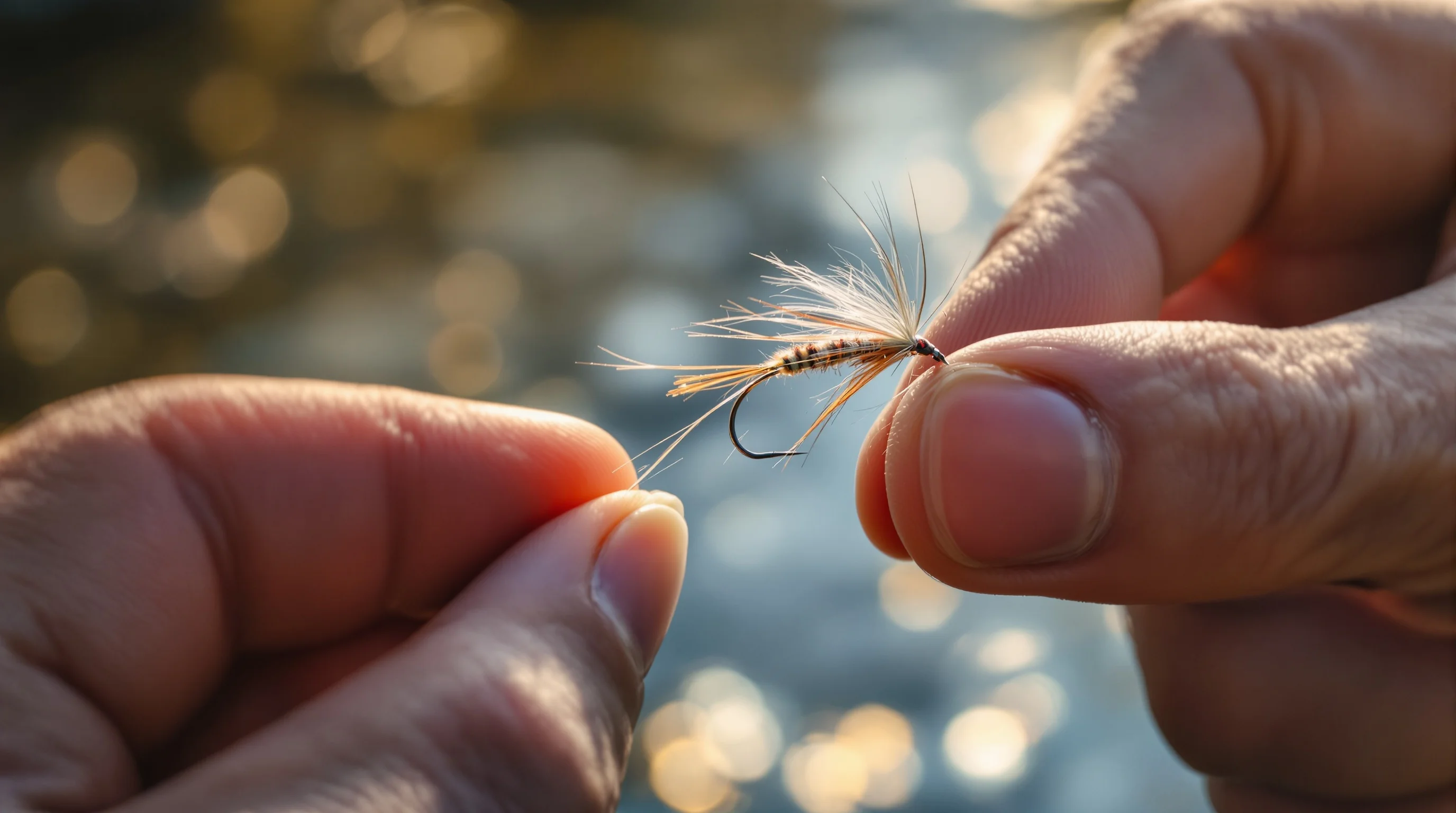
- Yarn substitute: Attach a small piece of yarn to the tippet during lawn practice to feel the loop form without worrying about a hook
- Knot prep: Learn the improved clinch knot (fly to tippet) and surgeon's knot (tippet to leader) at home before your first outing; both are covered clearly at Wired2Fish and in our guide to fly fishing knots for beginners
Presentation and Drift: What Actually Fools Fish
A technically clean cast means very little if the fly drags unnaturally across the current. According to OARS, natural drift is the defining factor in whether a trout takes your fly or ignores it entirely. Most beginner refusals are presentation problems. Fix the drift before changing the fly.
The upstream approach is the simplest way to start getting drift right. Cast at an angle upstream and let the fly travel naturally back toward you with the current. FishTalk Magazine notes this also keeps you downstream and out of the fish's sightline, and avoids muddying the water you're about to fish.
Line mending keeps a good drift alive after the cast lands. When conflicting currents start pulling your fly unnaturally, flip the rod tip upstream to reposition the line. A widely-watched beginner guide on YouTube captures the principle well: "One nice clean back cast, one nice forecast... you'll catch more fish the more your fly is on the water." Fewer false casts, more drift time.
Stealth belongs in your first session. According to OARS, trout in clear water respond to vibration, shadow, and bank disturbance. Wade slowly, approach low, and pause at the bank to watch for rises before stepping into the water. The angler who spends two minutes observing before casting will regularly outfish the one who covers the most water.
Starting with One Fly
Decision fatigue on the water pulls focus away from casting and presentation, where real learning happens.
- Woolly bugger as the starting fly: Durable and versatile across trout, bass, and bluegill, it forgives imperfect presentation and works in a wide range of conditions (Mossy Oak, 2024); our beginner fly selection guide covers when to expand from here
- Stripping retrieve: Pull line back in short, varied strips to simulate swimming prey; vary the speed and pause occasionally, since the pause often triggers the strike
Practical Habits That Separate Beginners Who Improve
Gear matters, but not in the way beginners often fear. Wired2Fish and OARS both point to the 9-foot, 5-weight rod as the practical starting point for freshwater beginners. It handles trout, panfish, and bass, and it's forgiving enough to teach proper casting form. Pair it with floating line for surface presentations; sinking line belongs after core casting mechanics feel natural.
A pattern shows up often among beginners who stall: they skip ahead to complex fly patterns or long casts before the fundamentals feel solid, then restart the same sequence the following season. The productive order is lawn practice first, then short upstream casts within fifteen feet of the bank, then drift focus, then gradual expansion. Each stage builds something the next stage requires.
A few common mistakes account for most early frustration, and they're all fixable:
- Too many false casts: Each one tires your arm and puts motion over the fish. One backcast, one forward cast.
- Wading before observing: Spend two minutes watching the water before stepping in. Look for rises, current seams, and holding lies.
- Changing flies before improving drift: Most refusals are presentation failures. According to OARS, a dragging fly gets refused regardless of pattern.
- Targeting water that's too demanding too soon: FishTalk Magazine recommends starting on small, forgiving fish. Panfish and small trout build hookset timing and presentation confidence without the pressure of selective, educated trout.
Why Learning These Fly Fishing Techniques in Order Matters
Fly fishing techniques for beginners compound on each other in a specific sequence. The overhead cast enables the roll cast. Clean casting frees your focus for drift. Drift awareness reveals where fish hold and what they're eating. As the Orvis Fly Fishing School emphasizes, each skill genuinely opens the next one. It's okay to spend three full outings just working on the overhead cast. That's time well spent, not time wasted.
Conclusion
Fly fishing techniques for beginners reduce to a short, learnable sequence: overhead cast, roll cast, natural drift, and one versatile fly. Accuracy and presentation outperform distance and pattern selection at every stage of early development. The angler who internalizes that early will progress faster than one chasing gear upgrades or complex techniques before the basics feel solid.
Practice the overhead cast on a lawn this week. Tie both essential knots at the kitchen table. On your first outing, commit to fishing close and watching the water before you wade in. Those rewards come to the angler who observes before acting. Tight lines.
Sources
- Mossy Oak - Foundational beginner casting techniques, fly selection, and overview of the basic overhead cast
- FishTalk Magazine - Beginner lessons emphasizing timing over power, fly simplicity, and targeting small fish first
- Orvis Fly Fishing School - Authoritative video-based instruction on overhead and roll cast fundamentals
- OARS - Practical trout fishing guidance including upstream casting, drift, and natural presentation
- Wired2Fish - Gear basics for beginners including rod weight, line selection, and essential knots
- YouTube Beginner Guide - How to Fly Fish - On-camera demonstration emphasizing short casts, clean loops, and keeping the fly on the water
- Grit - Overview of stripping retrieve technique, netting, and beginner gear considerations