
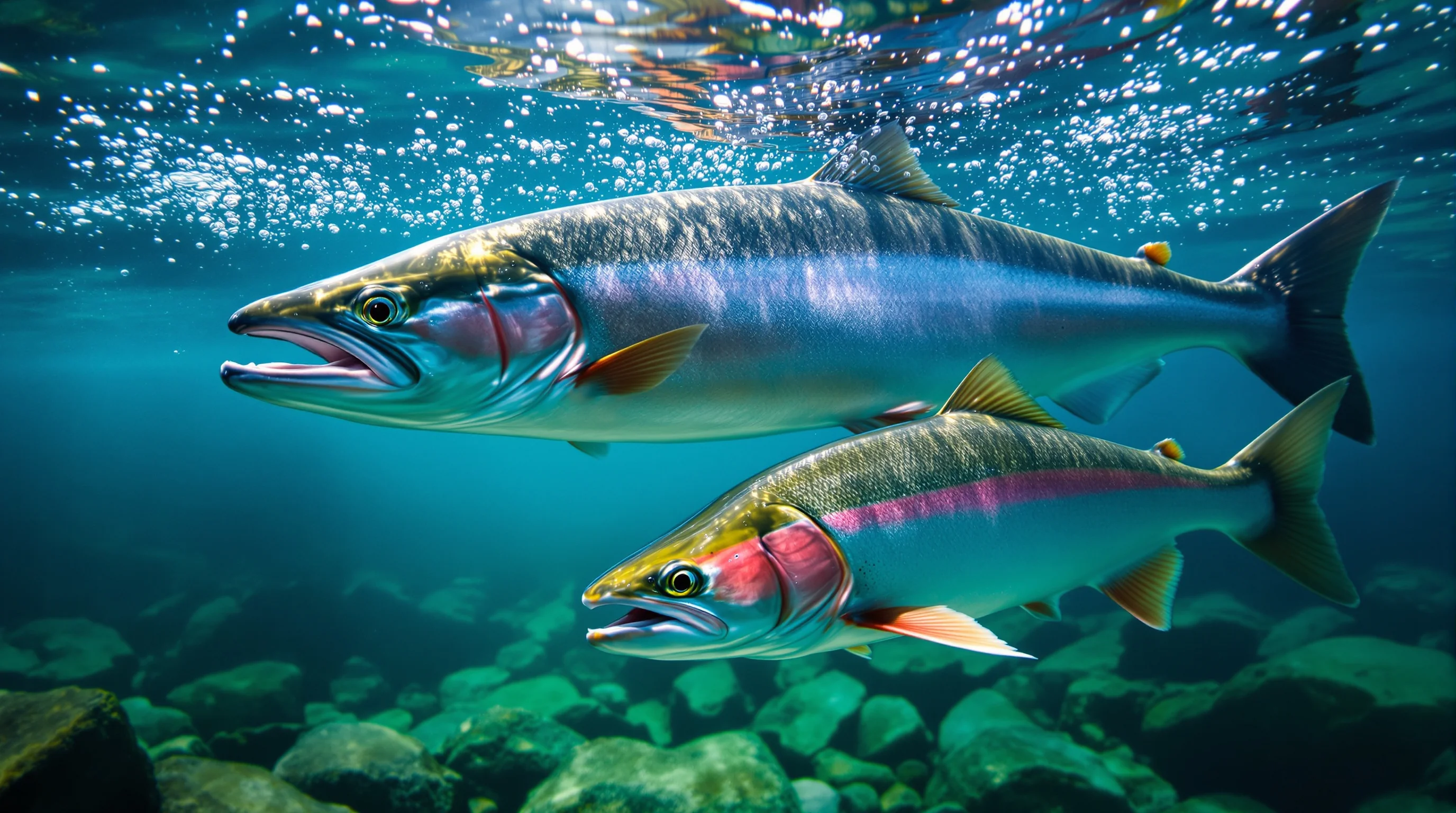
Salmon vs steelhead comes down to life history: steelhead are sea-run rainbow trout that can spawn more than once, while Pacific salmon die after spawning. Steelhead are ocean-going rainbow trout related to salmon through the shared genus Oncorhynchus.
Maybe you've felt it already: a bright fish in your hands on a Washington river, and a moment of doubt. King County notes that "Puget Sound steelhead are listed as Threatened," and Chinook carry Endangered Species Act protection too. Colors shift with time at sea and run timing overlaps, so the call takes a few quick checks.
Quick Answer: Salmon vs steelhead comes down to species and life history. Steelhead are sea-run rainbow trout, Oncorhynchus mykiss. Pacific salmon such as Chinook, coho, chum, pink, and sockeye are separate Oncorhynchus species. Most Pacific salmon die after spawning, and steelhead can survive and spawn again. In the hand, a pure white mouth points to steelhead.
Definition: Steelhead refers to the anadromous, or sea-run, form of rainbow trout, distinct from Pacific salmon species that share the same genus but die after spawning.
Key Evidence: According to King County, "Steelhead are the anadromous (migrating) version of rainbow trout. Rainbow trout are the 'land locked' version, and remain in freshwater throughout their life."
Context: Because steelhead can survive spawning, King County notes they fall outside the "official" Pacific salmon group.
Key Takeaways
- Same species as rainbow trout: Steelhead are the ocean-going form of Oncorhynchus mykiss, according to California Sea Grant.
- Repeat spawners: Steelhead can spawn again, while Pacific salmon die after spawning, per NOAA Fisheries.
- Mouth first: An all-white mouth is the strongest single steelhead clue in the hand.
- Confirm with tail and jaw: Tail spotting, body shape, and jaw shape support the call.
- Check current rules: Retention rules differ and change, so confirm with WDFW before keeping anything.
Salmon vs Steelhead: Species and Life History
Steelhead and coastal rainbow trout "are the same species (Oncorhynchus mykiss). Steelhead migrate to the ocean while coastal rainbow trout stay in streams," according to California Sea Grant. Pacific salmon form a separate group: Chinook, coho, chum, pink, and sockeye.
King County draws the line this way: "because steelhead are not semelparous (meaning they do not die after spawning) they are not an 'official' Pacific Salmon." Scientists still debate classification. Steelhead once sat in the genus Salmo with Atlantic salmon, and most researchers now place them in Oncorhynchus, per the Pacific Salmon Foundation.
Great Lakes steelhead follow the same pattern with a different ocean. Michigan DNR describes them as "migratory rainbow trout that are born in rivers but spend most of their lives in the ocean or the Great Lakes."
The mechanism is simple. Salmon put everything into one run, and their bodies then feed the stream. Repeat spawning, not appearance, is what separates the groups biologically.
Why Steelhead Can Spawn Again
Steelhead sometimes survive spawning and get another chance to breed.
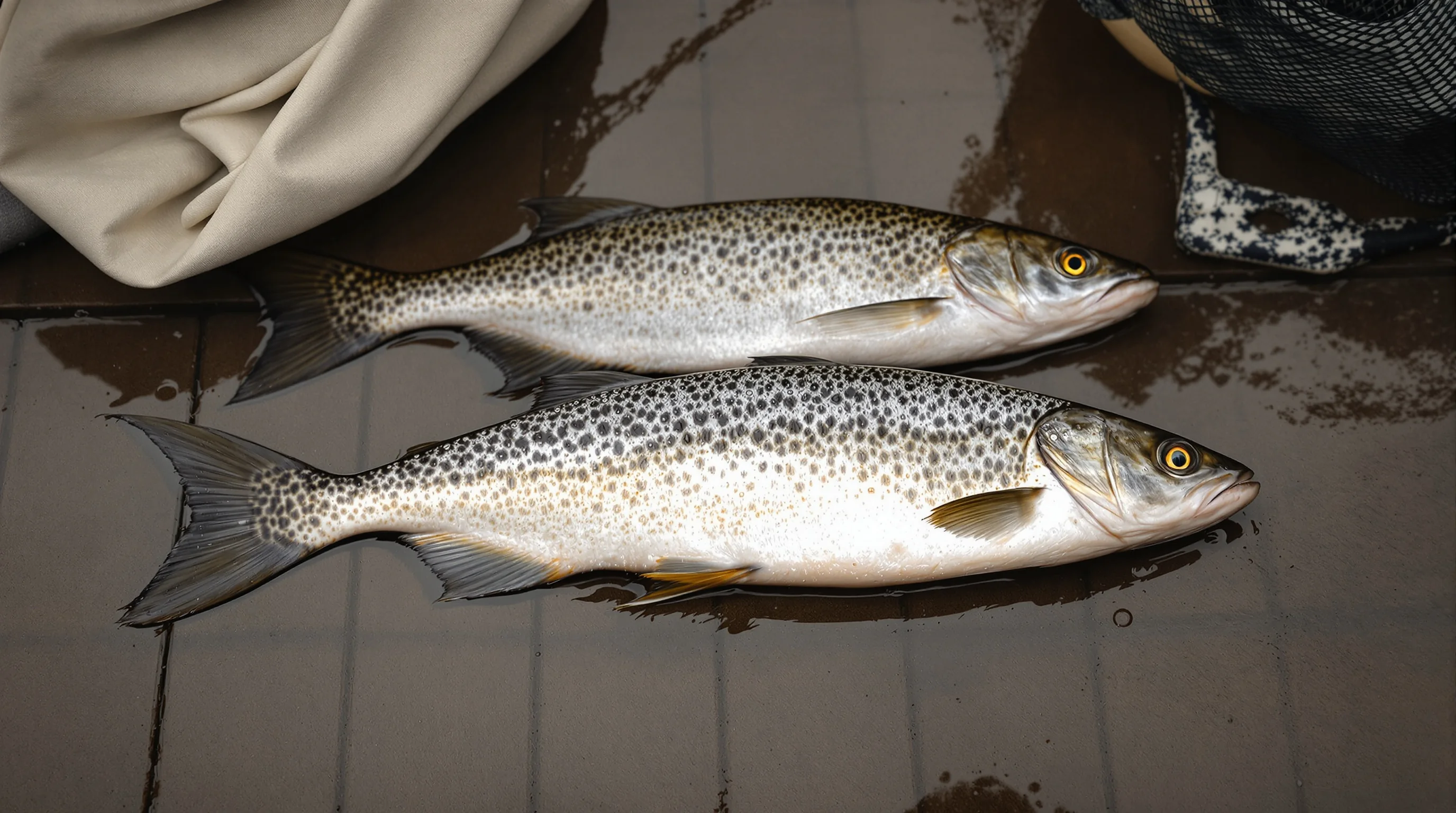
- Salmon: "After spawning, adult salmon die and their bodies provide nutrients for the freshwater ecosystem," per NOAA Fisheries.
How to Tell Salmon and Steelhead Apart in the Hand
Check the mouth first, then the tail, body, and jaw. California Sea Grant states plainly that "the most definitive characteristic for identification is the pure white mouth." For coho, the tell flips: a white gum line against a dark mouth.
| Feature | Steelhead | Chinook | Coho |
|---|---|---|---|
| Species | O. mykiss (sea-run rainbow trout) | O. tshawytscha | O. kisutch |
| After spawning | Can survive and spawn again | Dies | Dies |
| Mouth and gums | All white mouth | Dark mouth, dark or black gums | Dark mouth, white gums |
| Tail spots | Both lobes, often in straight lines | Both lobes | Upper lobe only |
| Body | Longer and more simplified | Largest and deepest bodied | Deeper bodied than steelhead |
| Kype | Lower jaw, if present | Upper, less bulbous than coho | Upper hook-nose on mature males |
| Color | Pink cheeks and flanks, smaller spots | Brownish-green, large "W" spots | Green head, maroon flanks when mature |
King County adds Washington-specific cues: a steelhead's head is blunt with a "jaw short, does not extend past the eye," dark spots show on the dorsal fin, and the tail is "square-shaped" with a radiating pattern of spots. For Great Lakes steelhead, Michigan DNR lists "10-12 rays in anal fin," though that count applies to that region.
Color alone is a weak clue. The more recent a steelhead's time at sea, the more it takes on salmon-like dark blue backs and silvery sides, according to the Pacific Salmon Foundation.
A pattern that shows up often: an angler lifts a chrome-bright fish from a winter river and calls it steelhead on color alone. Then a glance inside the mouth shows dark gums and a spotted upper tail lobe. The fish was a coho, and the quick mouth check caught what the silver sides hid. It's okay to pause and look twice, because every angler gets fooled by fresh chrome at some point.
Cutthroat and Other Look-Alikes
King County flags two common mix-ups worth knowing.
- Cutthroat trout: A long jaw that "extends past eye" and "red to yellow streaks on underside of jaw" set it apart.
- Spawning coho: They can turn red in shared streams and get mistaken for sockeye.
- Individual variation: California Sea Grant notes "not every fish will display all of these characteristics," so no single feature settles every case.
Why Salmon vs Steelhead Matters to Washington Fly Anglers
Salmon vs steelhead identification decides what you're allowed to keep. King County states that "only hatchery steelhead can be caught and kept." Rules shift, so check the current Washington Department of Fish and Wildlife regulations before every trip.
NOAA Fisheries "has listed 28 population groups of salmon and steelhead on the West Coast as threatened or endangered." NOAA links the declines to "habitat alterations, hydroelectric development, and consumptive fisheries," and notes Puget Sound has lost "more than 80 percent of tidal wetlands."
Run timing offers a rough biological clue. Winter-run steelhead travel to spawning grounds "from November to April," while summer-run fish move "from April to September," according to NOAA. Open seasons come from WDFW, not from biology.
Identification matters because each wild steelhead released has a chance to return and spawn again. Trout Unlimited describes steelhead as putting "their eggs into a relatively large number of baskets," a diversity that steadies populations through hard years. A correct call on the bank protects that margin.
For river-specific tactics once you've made the call, see our guides to Olympic Peninsula steelhead on the swing, fly fishing the Skagit River for steelhead and bull trout, and targeting coho and pink salmon in Puget Sound.
Conclusion
Salmon vs steelhead comes down to a species question with real consequences on the water. Steelhead are sea-run rainbow trout that can spawn more than once, while Pacific salmon die after a single run. Look at the mouth first, confirm with tail spots, body shape, and jaw, and remember that individual fish vary.
Read the current WDFW regulations before heading out, then plan your next trip with the guides above. Tight lines, and here's to reading the water a little more clearly next time.