
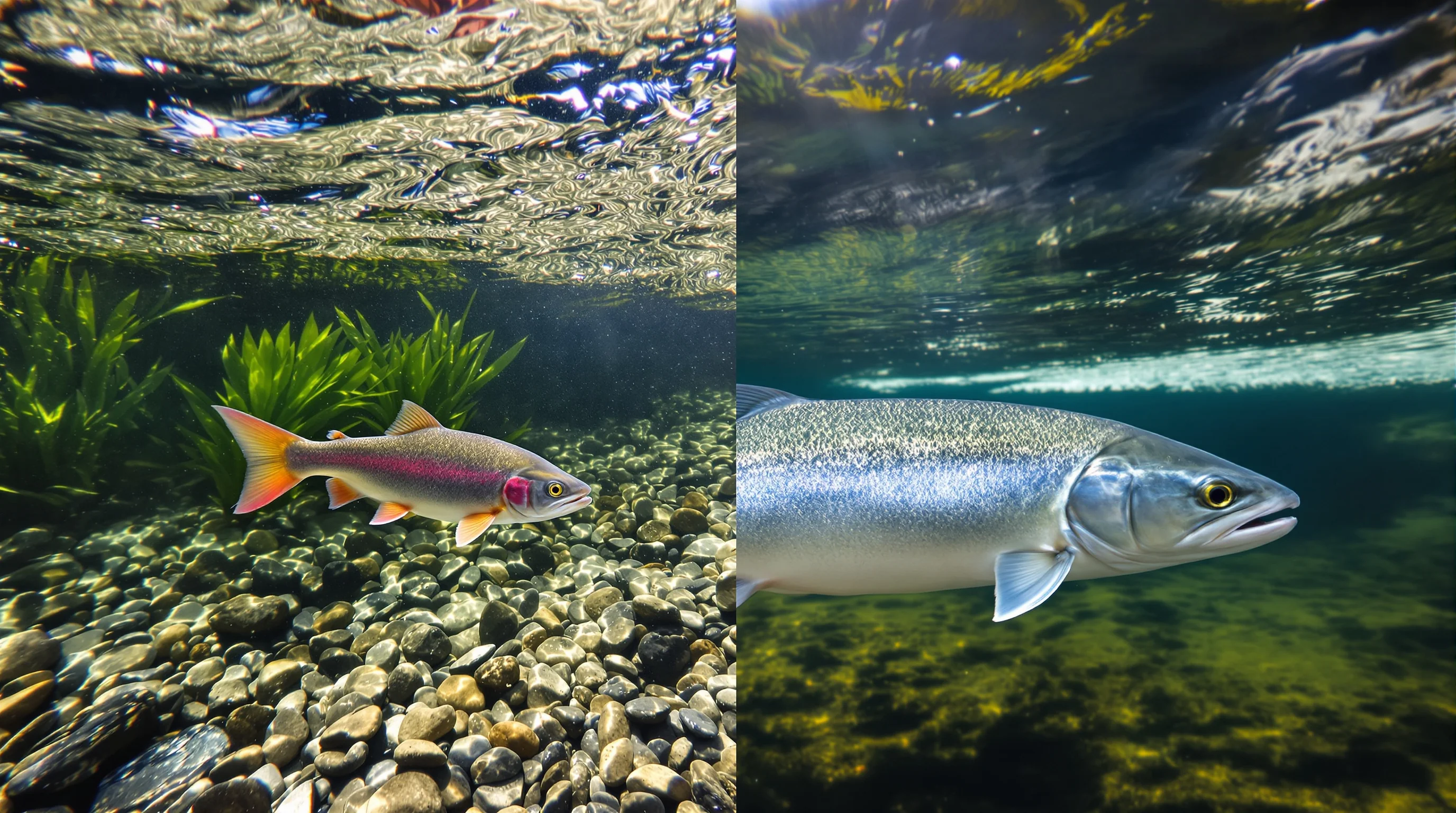
Steelhead and rainbow trout can be siblings, because "the same parents can produce both steelhead and Rainbow Trout offspring," according to Oregon Sea Grant. The steelhead vs rainbow trout question matters because it shapes how you identify a catch and which rules apply. Steelhead are not a separate species. They are rainbow trout that spend part of their lives at sea.
This article explains why some rainbows go to sea, how size, color, and body shape change along the way, and how anglers approach each form with a fly rod.
Quick Answer: Steelhead and rainbow trout are the same species, Oncorhynchus mykiss, living two different life histories. Rainbow trout stay in fresh water for life. Steelhead are anadromous: they migrate to the ocean to feed and grow, then return to rivers to spawn. Ocean feeding makes steelhead larger, more silver, and more simplified than most resident rainbows.
Definition: Steelhead refers to the anadromous, sea-run life-history type of rainbow trout, while a resident rainbow trout completes its entire life cycle in fresh water.
Evidence: According to the Washington Department of Fish & Wildlife, "Steelhead and rainbow trout are the same species, but rainbow are freshwater only, and steelhead are anadromous, or go to sea."
Key Evidence: NOAA Fisheries states that "Those that stay in fresh water all their lives are called rainbow trout (nonanadromous)," confirming that the two names describe one species with two life histories.
Context: "Steelhead" names a life-history type, not a separate species, so the label describes how a fish lives rather than what it is.
Water temperature appears to push some young fish toward the ocean and others toward staying put. Colder, more stable freshwater favors residency, while the migratory path trades early risk for the growth that ocean feeding delivers. That growth turns a fish from the same gene pool as a small resident rainbow into a large, silver steelhead. The sections ahead cover that mechanism, the physical changes it produces, and how anglers adjust for each form.
Key Takeaways
- One species: NOAA calls steelhead a "life-history type of rainbow trout."
- Shared parents: Either form can produce the other, according to Oregon Sea Grant.
- Size gap: Washington steelhead average 8 to 11 pounds, while rainbows average 11 to 18 inches.
- Looks overlap: Juveniles are indistinguishable, and the ocean silver sheen fades once a steelhead spends time back in fresh water.
- Rules vary: Check current state regulations before fishing, since rules vary.
Steelhead vs Rainbow Trout: One Species, Two Life Histories
Steelhead and rainbow trout are one species living out two plans. As NOAA Fisheries puts it, "Those that stay in fresh water all their lives are called rainbow trout (nonanadromous)."
Both forms begin the same way. "All wild steelhead hatch in gravel-bottomed, fast-flowing, well-oxygenated rivers and streams," notes NOAA. Resident rainbows "either remain in their natal rivers their entire lives or migrate between rivers and lakes," according to Oregon Sea Grant. Parentage follows no fixed script: offspring of two steelhead can settle into a resident life, and offspring of two resident rainbows can head to sea, according to the National Wildlife Federation.
Second-time returns typically make up 20 to 30 percent of a run, according to ADF&G. To see how steelhead and bull trout share a sea-run river, read our guide to fly fishing the Skagit River.
Large rainbows that run from the Great Lakes into tributaries are called both "steelhead" and "lake-run rainbows" by outfitters like Orvis. The behavior is the same, just without an ocean.
Why Some Rainbows Go to Sea
Science offers a working explanation, though it remains a hypothesis rather than settled fact.
- Temperature hypothesis: Water temperature and its variation may drive the outcome, "with colder thermal regimes resulting in greater residency and earlier maturation," per Oregon Sea Grant.
- Environment shapes the outcome: NOAA notes that "individuals develop differently depending on their environment."
How Size, Color, and Body Shape Change at Sea
Ocean feeding drives nearly every physical difference between steelhead and resident rainbows. Oregon Sea Grant lists resident rainbows at 1 to 1.5 pounds and 6 to 16 inches, while steelhead can reach 45 pounds and 45 inches, a gap it credits to "feeding in food-rich ocean waters." WDFW reports a narrower spread: rainbows averaging 11 to 18 inches, steelhead averaging 8 to 11 pounds. Figures shift by agency and region, so treat any single number as a regional snapshot.
Growth happens fast. At sea, steelhead "can grow an inch per month," according to ADF&G, which records the Alaska state record for rainbow and steelhead at 42 pounds, 3 ounces, caught at Bell Island in 1970. The richer menu explains it: ocean-going steelhead eat "squid, anchovies, smelt, herring, and other fishes," while rainbows stick mostly to invertebrates, salmon eggs, and small fish, per Oregon Sea Grant. Our guide to seasonal migration patterns of trophy trout shows how feeding shifts with the seasons.
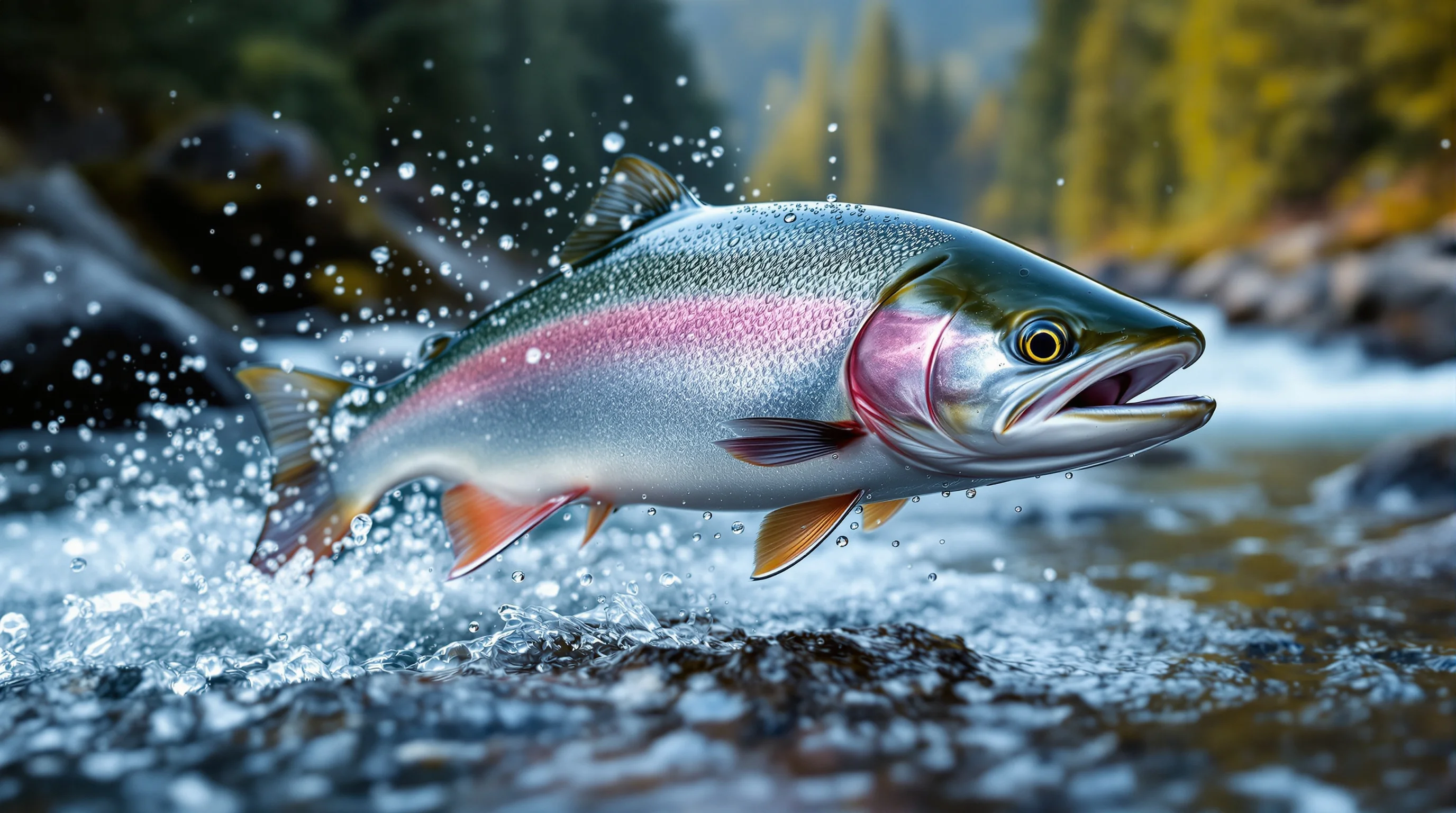
Color tells part of the story. Fresh-run steelhead arrive "very bright and much more silver," while stream residents carry "the most intense pink stripe coloration and heaviest spotting," according to ADF&G. Steelhead also tend to have a more slender, sleeker body than stream resident rainbow trout, per the same source.
Why Color Alone Can Mislead
ADF&G describes the visual differences as subtle, and they shift over a fish's life.
- Juveniles look identical: Young steelhead are "indistinguishable from juvenile rainbow trout."
- Silver arrives early: Smolts lose their parr marks and turn silvery before they reach salt water.
- Silver fades: After time back in fresh water, a steelhead "becomes difficult to differentiate from mature resident rainbow trout."
One common pattern looks like this: you hook a thick, 20-inch fish in a coastal river in late fall, and its flanks are dull and heavily spotted. You wonder whether it's a steelhead that's been in the river for months or a big resident. It's okay to be unsure. Even biologists lean on context, not paint, to answer that.
How Anglers Fish Steelhead vs Rainbow Trout
Tactics differ mostly because of where and when each fish shows up. Both eat a well-presented fly, but the water they occupy changes the approach.
For steelhead, most anglers rely on swinging flies and nymphing. Orvis names nymphs, eggs, and swung streamers as tested choices for Great Lakes steelhead, and the same toolkit applies on coastal rivers. "Spawning fish rarely feed," per Oregon Sea Grant, so presentation and drift carry as much weight as fly choice. Run timing is regional: Washington has distinct summer and winter runs, with most summer-run fish entering east of the Cascades, according to WDFW. Our Olympic Peninsula steelhead guide walks through spey casting on classic coastal water.
Resident rainbows reward a different rhythm. Dries and nymphs cover most days, and WDFW notes that spinners, spoons, jigs, flies, wedding rings, and plugs also work where legal. In summer heat, rainbows "seek deeper, cooler water," so lake anglers often fish flies near the bottom rather than the surface.
Regulations deserve real attention. Before heading out, check current rules for your river, for example through the WDFW sportfishing rule pamphlet or the Fish Washington app.
Why the Steelhead vs Rainbow Trout Distinction Matters
Wild steelhead face threats from dams, culverts, habitat loss, and climate change, according to NOAA Fisheries. Any large trout in a coastal river could be a protected steelhead, so knowing the difference helps you handle fish carefully and follow the rules that protect them. It also sharpens how you read water, since a river of resident rainbows asks for a different approach than one hosting a seasonal steelhead run.
Conclusion
The steelhead vs rainbow trout question has a simple answer beneath all the variation: one species, split by whether a fish heads to the ocean or stays home. Size and color are tendencies, not proof. The water, the season, and the river tell you more about a fish's life than its silver flanks ever will.
Consider planning a trip around that migration with our Olympic Peninsula steelhead guide, or explore how seasonal movement shapes trout behavior in our piece on trophy trout migration patterns. Wherever you fish, check your state agency's current regulations before you wade in. Tight lines, and may your next fish surprise you with the life it's been living.