
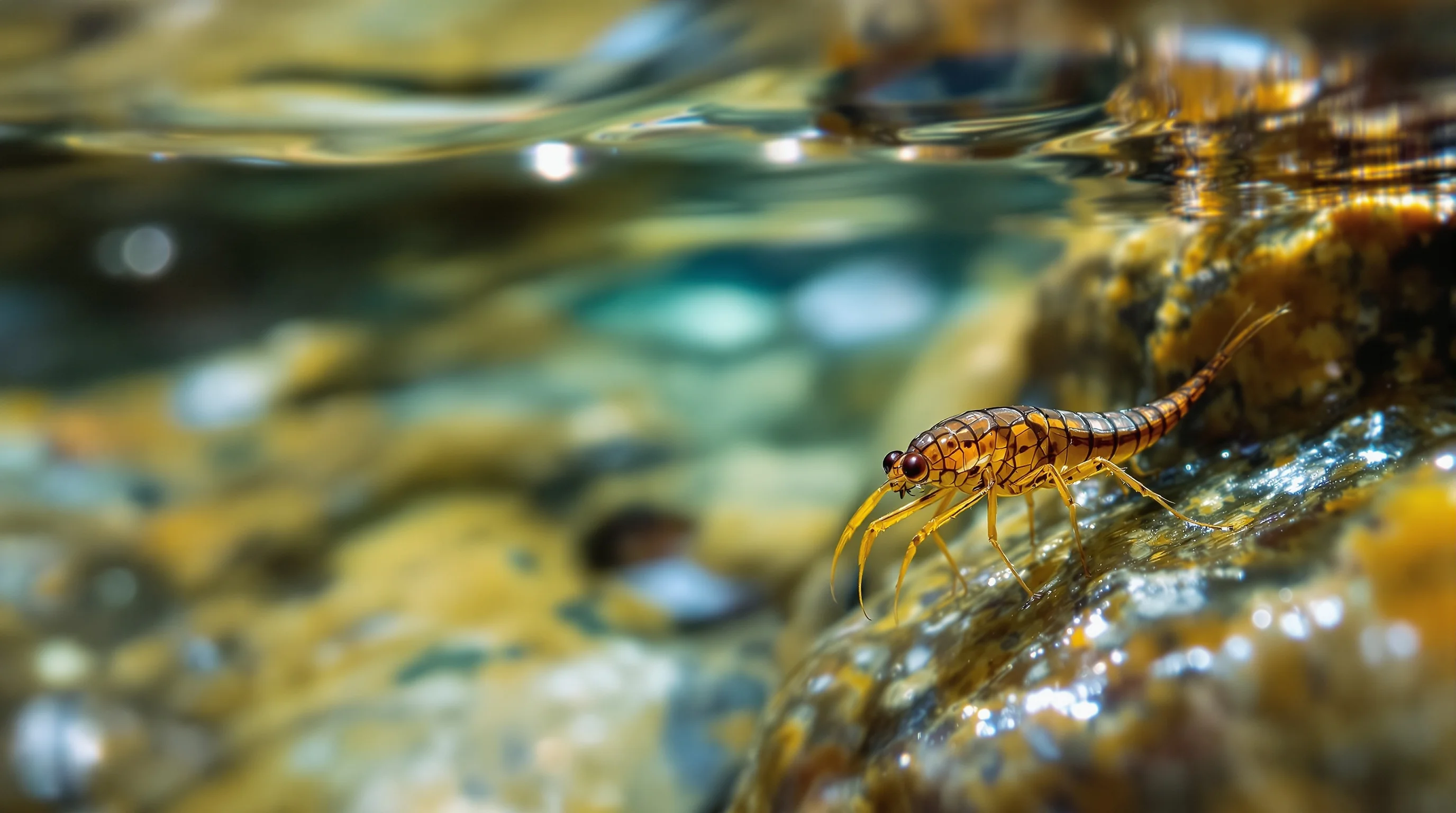
Trout see a stonefly nymph long before any hatch begins, because it can live on the river bottom for up to three years. According to Go Fish BC, "depending on the species, stoneflies can spend up to three years in the nymphal stage before emergence into an adult." That long underwater life makes the stonefly nymph a year-round food source in fast, rocky rivers. It earns a permanent place in your fly box.
A stonefly nymph is a constant presence in the drift that trout eat in every month. This guide covers how to identify one, where it lives, when the big Western hatches happen, and how to rig and fish the best patterns on the bottom.
Quick Answer: A stonefly nymph is the aquatic stage of the stonefly, with two prominent tails, two short antennae, and two wingcases. It crawls among rocks in fast, well-oxygenated water for up to three years. Anglers fish heavy imitations such as Pat's Rubber Legs, Kaufmann's Stone, and the Girdle Bug, usually in sizes 4 to 10, drifted drag-free along the bottom.
Definition: A stonefly nymph is the immature, bottom-dwelling stage of a stonefly, recognized by its paired tails, antennae, and wingcases, which can live one to three years before appearing as a winged adult.
Key Evidence: According to Go Fish BC, nymphs "can be from 20 to 45 millimetres in length, and range in colour from a yellowy-olive to brown to black."
Context: Because the nymphs stay present in the drift all year, a stonefly pattern remains a sound choice in any season.
Maybe you've stood on a riffle wondering what to tie on after the hatch chart came up empty. A weighted stonefly imitation answers that question. The natural lives among rocks for years, gets knocked loose by current and wading boots, and drifts past feeding trout all day. The sections below cover identification, hatch timing, and how to present these patterns where the naturals live.
Key Takeaways
- Identification: Look for two prominent tails, two short antennae, and two wingcases on the nymph's thorax.
- Long life: Nymphs live one to three years in clean, well-oxygenated freestone rivers before appearing.
- Golden stones: Imitations run sizes 4 to 8, with a hatch that typically runs May through July.
- Depth: Weighted patterns drift closer to the bottom, where the naturals crawl among rocks.
- Rigging: Pat's Rubber Legs works well as the point fly ahead of a smaller trailing nymph.
How to Identify a Stonefly Nymph and Where It Lives
A stonefly nymph is "easily recognized by their prominent two tails, two short antennae, and two wingcases," according to Go Fish BC. Flip over a rock in a riffle and look for that paired structure. Size and color vary by species: nymphs "can be from 20 to 45 millimetres in length," ranging from "yellowy-olive to brown to black" (Go Fish BC).
Go Fish BC says the nymphal stage lasts up to three years depending on species, while Fish Fly Water gives a range of "one to three years in clean, well-oxygenated freestone rivers."
Habitat tells you where to look. "Prime habitat for stonefly nymphs is the rocky bottom of a river's faster-moving sections," Go Fish BC notes, adding that "these insects require clean, well-oxygenated water to survive." The nymphs "are poor swimmers that crawl along the bottom among rocks and gravel," according to Fish Fly Water, and they "are always present in the drift, dislodged by current, wading anglers, and their own movements." A stonefly nymph is a bottom-dweller of fast, rocky rivers that trout can eat in every month of the year.
Stonefly Emergence and the Big Western Hatches
When emergence time arrives, "mature nymphs crawl along the bottom of the river to shore, and then crawl out of the water onto exposed rocks or shoreline vegetation" (Go Fish BC). That migration is where trout cash in, because "nymphs get swept off the bottom and become easy prey for fish." Emergence can happen "from early spring right through the summer months," and Fish Fly Water says feeding activity "intensifies in spring and early summer when nymphs migrate toward shore."
The West's best-known hatches follow predictable patterns of size and timing. According to Matthew Bernhardt at DriftHook, golden stone nymphs "run in sizes 4 to 8" and hatch "typically May through July, depending on elevation and latitude." Brown stoneflies run smaller, "size 8 to 12," and hatch "often February through April," by the same author's account. Fish Fly Water notes that the Western US became "the center of stonefly nymph pattern development." The nymphs swept loose during the crawl to shore are the main event for trout.
What Drives Emergence Timing
Researchers have found that emergence timing follows species and water temperature rather than a fixed calendar date.
- Species variation: "Emergence timing and duration varied among Plecoptera species," according to USGS research.
- Temperature effect: In Oregon Cascade streams, "peak emergence timing was earlier when stream temperature was higher," per an Oregon State University synopsis.
How to Fish a Stonefly Nymph: Patterns, Sizes and Depth
The right pattern in the right size makes a difference on a stonefly river. DriftHook lists Pat's Rubber Legs in "sizes 4 through 8," the Girdle Bug "available in sizes 4 through 10," Kaufmann's Stone in "sizes 4 through 10," and a tungsten-bead euro stonefly in "sizes 6 through 12." Fish Fly Water lists hook sizes 6 to 10 (2X-3X long) for a generic stonefly nymph. Go Fish BC also names the Montana Stonefly Nymph, Golden Stonefly Nymph, and Lambroughton's Titanic Stonefly Nymph as reliable choices.
Depth matters as much as the pattern. "Weighted nymph patterns will drift closer to the bottom," Go Fish BC notes, recommending a cast directly upstream or quartering upstream, then a drag-free drift back toward you. For more on weighting, see this guide to weight distribution in nymph rigs and our full breakdown of deep water nymphing.
Fish Fly Water recommends a "tight-line or Euro-nymphing approach for maximum control," or fishing beneath a strike indicator "with sufficient weight to reach the substrate." Dead-drifting through prime lies is the main technique, though "occasionally tumbling the fly along the substrate or adding slight movement can trigger strikes."
Target "boulder-strewn runs, pocket water behind rocks, deep riffles, and along rocky banks" (Fish Fly Water). DriftHook adds that fishing "often gets better after a rain event," since high flows dislodge nymphs. Picture a pocket behind a boulder after a spring storm: that is where a size 6 stonefly, ticking along the bottom, tends to get eaten.
Rigging a Stonefly Nymph as the Point Fly
A big stonefly anchors a two-fly rig and pulls a smaller nymph down through the water column.
- Point fly: Pat's Rubber Legs serves as "the go-to point fly for nymph rigs on the Madison, Yellowstone, and Gallatin rivers," per Fish Fly Water.
- Trailer options: Pair it "with a smaller trailing nymph like a Pheasant Tail or Lightning Bug," or a Copper John in sizes 8 through 14 (DriftHook).
- Full rig construction: See our guide to multiple nymph rigs for tippet length and dropper placement.
Why Stonefly Nymphs Matter
Stonefly nymphs matter because they feed trout all year. Go Fish BC calls the stonefly nymph "always a good pattern to choose," and Pat's Rubber Legs alone "produces fish 12 months of the year" (Fish Fly Water). These insects also need clean, well-oxygenated water, so a healthy population says something good about the river itself.
Conclusion
Identify a stonefly nymph by its two tails, two short antennae, and two wingcases, and look for it crawling among rocks in fast, well-oxygenated water. Carry heavy stonefly nymph patterns in sizes 4 to 10, fish them drag-free on the bottom, and try one as the point fly on a two-fly rig. Check current regulations, seasons, and tackle rules with your state wildlife agency first, since they vary by water and by year.
Then explore our guides to deep water nymphing, multiple nymph rigs, and advanced nymph pattern selection to refine your setup. Notice how the fish respond on your next day out, and let the river teach you the rest. Tight lines.