
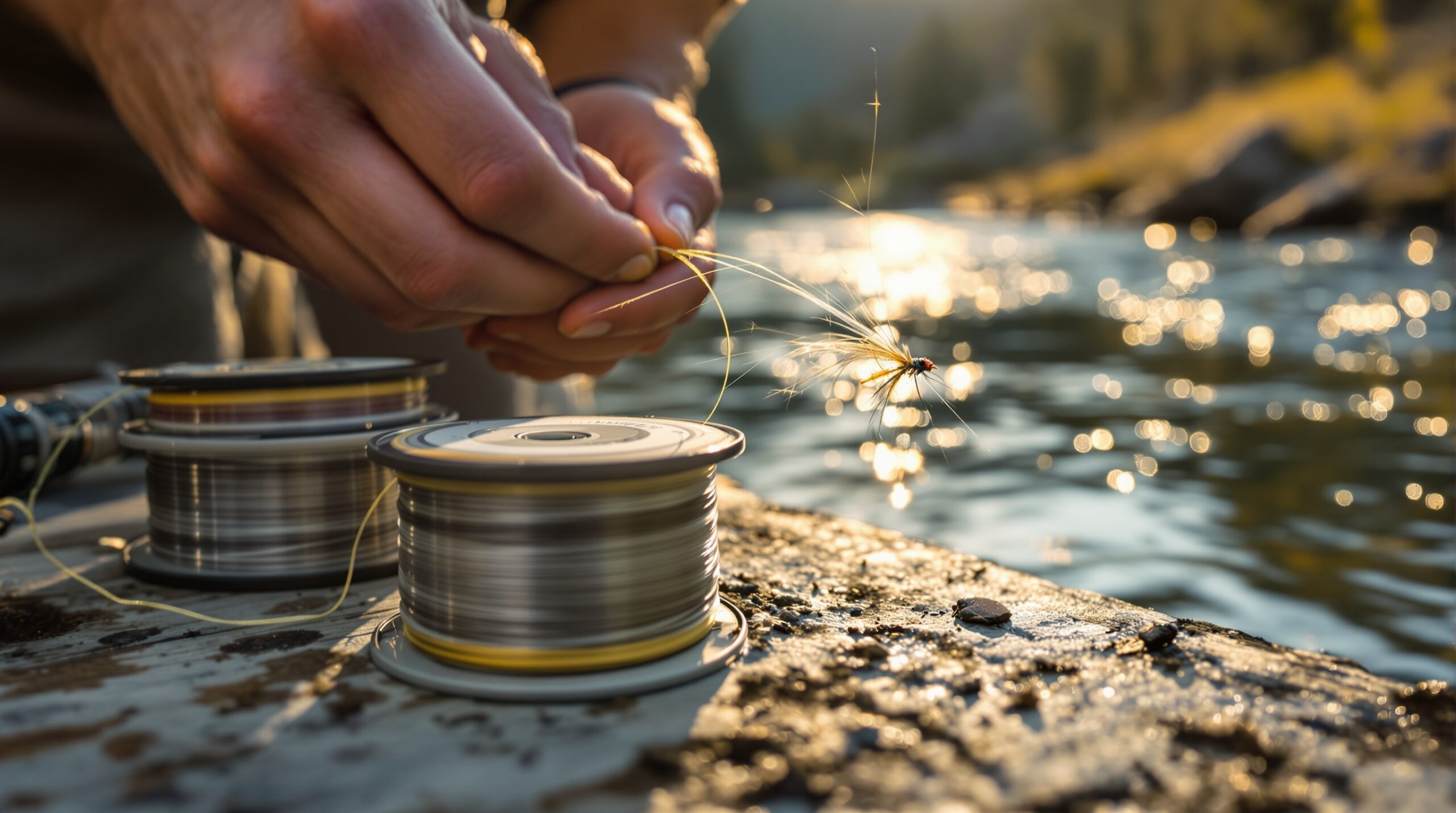
Every fly angler faces that heart-sinking moment when a trophy trout breaks off during the fight—often because tippet selection prioritized the wrong variable. Fly fishing tippet choice involves balancing diameter, breaking strength, and presentation quality across varying water conditions and target species. Fly fishing tippet is not about fishing the finest possible diameter. It is about using the heaviest tippet that maintains natural presentation, stepping down only when water clarity, spooky fish, or drag issues demand finesse.
This guide explains the X-rating system, material differences, and situation-specific selection criteria that help you make confident choices on the water. The sections that follow will walk you through the standardized sizing system, technique-specific applications, and real-world selection strategies that transform frustrating break-offs into successful landings.
Quick Answer: Choose fly fishing tippet by dividing your hook size by three to determine X-rating (size 12 fly = 4X), then adjust down one size for clear water or spooky fish, or up one size for wind, current, or abrasion resistance needs.
Definition: Fly fishing tippet is the final section of transparent line connecting your leader to the fly, sized by an X-rating system that balances diameter, strength, and presentation quality for specific fishing conditions.
Key Evidence: According to Orvis, tippet sizes range from 8X (0.003” diameter, ~1.75 lbs breaking strength) to 0X (0.011-0.012” diameter, 14-18.5 lbs breaking strength).
Context: The X-rating system provides a standardized framework, though actual breaking strengths vary between manufacturers and materials.
Key Takeaways
- The divide-by-three rule simplifies selection: hook size ÷ 3 = X-rating for reliable starting point
- Material matters for performance: fluorocarbon for nymphing abrasion resistance, nylon for dry fly suppleness
- Water clarity dictates diameter: drop one X-size in gin-clear conditions, increase one in off-colored water
- Technique-specific requirements vary: 6X-7X for dry flies, 4X-5X for nymphs, 0X-3X for streamers
- Use the heaviest tippet that maintains natural presentation—step down only when conditions demand it
Understanding the Fly Fishing Tippet X-Rating System
Maybe you've stood streamside, staring at your tippet spool collection, wondering which size actually matches the conditions you're facing. The X-rating system spans eight sizes from 8X to 0X, with smaller numbers indicating thicker diameters and higher breaking strengths. This standardized framework helps anglers match tippet to fly size and target species across different water conditions.According to Orvis research, the standard range extends from 8X (0.003” diameter, ~1.75 lbs) for size 22-28 flies up to 0X (0.011-0.012” diameter, 14-18.5 lbs) for size 1/0-2/0 flies. The divide-by-three rule provides a reliable starting point: size 12 fly equals 4X tippet, size 18 fly equals 6X tippet. This mathematical approach eliminates guesswork and creates consistency across varying fishing situations.
Brand variations create significant differences you need to understand before heading to the water. Wild Water rates their 5X at 4.4 lbs breaking strength with 0.150mm diameter, while other manufacturers may vary substantially at the same X-rating. The fundamental principle remains consistent: use the heaviest tippet that allows natural presentation, stepping down only when water clarity, spooky fish, or drag issues demand finesse.
5X tippet has emerged as the middle-ground workhorse for most trout fishing with size 16 flies in moderate flows. From this baseline, you adjust up or down based on specific conditions encountered on the water.
Common X-Rating Mistakes
Anglers often misapply the X-rating system through assumptions that compromise their fishing success.
- Assuming universal standards: Breaking strengths vary significantly between brands at identical X-ratings
- Fishing too light: Losing quality fish to preventable break-offs when conditions didn't require ultra-fine tippet
- Ignoring the starting point: Skipping the divide-by-three calculation and guessing based on feel alone
Matching Tippet to Fishing Techniques and Water Conditions
Different fly fishing methods impose distinct demands on tippet performance, from delicate turnover required for dry fly presentation to abrasion resistance needed when bouncing nymphs along rocky substrate. You might notice that your 7X tippet works beautifully for size 20 Blue-winged Olives in flat water but snaps repeatedly when nymphing pocket water with the same diameter.According to Red’s Fly Fishing, dry fly presentations with size 16-20 patterns in clear water require 6X-7X for the soft landing and low visibility that selective trout demand during hatches. Nymphing scenarios with flies ranging from size 8-22 call for 4X-5X tippet that prioritizes sink rate and abrasion resistance over delicacy.
Streamer fishing and pursuit of aggressive species demand moving to 0X-3X tippets that provide turnover authority needed for large, wind-resistant patterns. Research from Jackson Hole Fly Company emphasizes using “the largest tippet possible for accurate casts and strength, dropping to thinner for clear water, spooky fish, or drag issues to improve presentation.”
Water clarity modifications follow straightforward principles: drop one X-size in exceptionally clear conditions or when encountering visibly spooked fish, increase one X-size in off-colored water or during windy conditions that challenge casting accuracy. Current speed also influences selection—fast water allows heavier tippet as drag concerns diminish, while slow, technical water demands finer diameters for extended drag-free drift.
Material Selection by Technique
Modern tippet materials offer distinct performance characteristics suited to specific presentations.- Nylon advantages: Superior suppleness for floating patterns, better shock absorption during aggressive takes, ideal for dry fly work
- Fluorocarbon benefits: Sinks faster for nymphing, near-invisibility beneath surface, resists abrasion from subsurface structure
- Contemporary formulations: Advanced polymers provide improved strength-to-diameter ratios across both material types
Practical Application and Real-World Selection
A common pattern shows up when anglers overthink tippet selection: they start with 7X because the water looks clear, then wonder why their size 12 Stimulator won't turn over properly in the wind. Start with the divide-by-three baseline, then adjust for specific conditions you encounter on the water. A size 12 Adams begins with 4X tippet, modified based on water clarity and fish behavior observed during your session.Consider a spring creek scenario where educated trout inspect every element of your presentation. Approach with a 9-foot leader tapered to 5X, then add 18 inches of 6X tippet for size 16 Pale Morning Dun patterns in clear water. If fish refuse your quality presentation despite proper technique, extend to 24 inches of 6X or step down to 7X before changing fly patterns. Tippet diameter often influences refusals more than pattern selection in technical water.
Best practice for nymphing involves using 4X-5X fluorocarbon for most scenarios, accepting the slightly heavier diameter in exchange for durability when your rig contacts rocky substrate repeatedly. Streamer work requires 0X-3X for turnover authority and shock absorption during explosive strikes from aggressive species that test your tackle’s limits.
According to Jackson Hole Fly Company, contemporary anglers carry multiple tippet sizes (typically 3X through 7X), adjusting throughout the day as conditions shift. Modern tippet formulations allow anglers to fish finer diameters without compromising knot strength or durability, expanding the sweet spot between stealth and reliability. Check tippet condition regularly and replace spools showing UV degradation or after extended use, as material properties deteriorate over time.
Why Fly Fishing Tippet Selection Matters
Proper tippet selection represents the final connection between angler and fish—the element that either lands trophy trout or results in heartbreaking break-offs. As water conditions become more technical and fish more educated, the ability to balance presentation quality with fighting strength separates successful anglers from those watching their fly line drift away attached to nothing. Master this skill and transform frustrating losses into memorable catches.Conclusion
Choosing the right fly fishing tippet begins with the divide-by-three rule for your hook size, then adjusts based on water clarity, current speed, and fishing technique. Use 6X-7X for delicate dry fly work in clear water, 4X-5X for nymphing durability, and 0X-3X for streamers and aggressive species. The fundamental principle remains constant: fish the heaviest tippet that maintains natural presentation, stepping down only when conditions specifically demand finer diameter. Master these situation-specific guidelines by practicing with your leader setup, and you'll land more fish while experiencing fewer heartbreaking break-offs on quality trout. When you do encounter tippet breaking problems, you'll have the knowledge to diagnose and correct the issue for your next outing. For comprehensive guidance on selecting the right fly fishing flies for different water conditions and seasons, you'll find these tippet principles integrate seamlessly with pattern selection for maximum presentation effectiveness.Sources
- Orvis - Comprehensive tippet size chart with breaking strengths and recommended fly sizes
- Wild Water Fly Fishing - Brand-specific nylon tippet specifications and diameter measurements
- Jackson Hole Fly Company - Expert guidance on matching tippet and leader to fishing conditions
- Dutch Flies - Divide-by-three rule for tippet-to-hook-size matching
- Red's Fly Fishing - Technique-specific tippet recommendations and material comparisons